
Op-Ed
When video of the October 14th edition of Thom Hartmann's TV show appears online (here) it will include him asking me to justify not attacking Hitler. Thom has asked me this repeatedly during multiple appearances on his show, each time a little differently, and each time provocatively. He's right to ask it, and he's been right in some of the answers he's helped provide in the asking.
Without Hitler, the U.S. military would collapse.
For 68 years, wars on poor countries have been justified by the pretended discovery of Hitler's reincarnation. Each time it has turned out to be a false alarm. Every post-WWII war looks disastrous or at least dubious in retrospect to most people. And yet, the justification of the next war is always ready to hand, because the real, original Hitler remains alive in our memories, and he just might come back -- who's to say?
Actually, I think anyone vaguely aware of basic facts about the current world ought to be able to say that Hitler is gone for good.
How do I justify not going to war with Hitler, beyond explaining that Assad isn't Hitler, Gadaffi isn't Hitler, Hussein isn't Hitler, and so on?
Without Hitler, the U.S. military would collapse.
For 68 years, wars on poor countries have been justified by the pretended discovery of Hitler's reincarnation. Each time it has turned out to be a false alarm. Every post-WWII war looks disastrous or at least dubious in retrospect to most people. And yet, the justification of the next war is always ready to hand, because the real, original Hitler remains alive in our memories, and he just might come back -- who's to say?
Actually, I think anyone vaguely aware of basic facts about the current world ought to be able to say that Hitler is gone for good.
How do I justify not going to war with Hitler, beyond explaining that Assad isn't Hitler, Gadaffi isn't Hitler, Hussein isn't Hitler, and so on?
The government shutdown engineered by the Republican tea party zealots in the House of Representatives is headed into its third week. The damage is spreading. Infants go without nutrition. Children are locked out of pre-school programs. Scientists are losing support and locking up labs.
The people taking the biggest hit, of course, are public employees — the workers who serve the American people. Some 800,000 of them were initially furloughed without pay. Ironically, those deemed the most essential are paying the highest price.
“Essential” government employees are now, as Jeffrey David Cox, the president of the American Federation of Government Employees, told me on my radio show, essentially “indentured servants.” They’re forced to work without pay. About half of AFGE’s 670,000 members are deemed “essential.” They are required to work, and face disciplinary action if they don’t. But they aren’t getting paid and won’t be until the shutdown ends and Congress decides to vote them retroactive pay.
These employees include nurses, food inspectors, janitors, firefighters and more. Most are not big earners.
Image

It is 4:12 PM on Saturday, and I am drunk and waiting to go on the Santa Maria. It is Experience Columbus Day, so the tours are half off. Live music and a taco truck are summoned to provide the festive atmosphere for this celebration of colonialism. This floating homage to genocide is a popular site for field trips; I remember going on one in early elementary school. As I wait for the tour to start, one such assortment of suburban teenagers is role-playing in front of the ship for some sort of official photo-op. In a truly transcendent bit of colorblindness, the person playing Christopher Columbus is a black girl, the sole presence of diversity in the group. I'm too far away to hear what they're saying, but it's obvious this girl is having trouble, because whenever they start the scene, she cracks up laughing, to the mystification of all the white people surrounding her. Certainly some of this is nerves, but she is also clearly on to something that her fellow cast members are not: the fundamentally absurd and terrifying nature of the presence of this 62-foot carrack on the Scioto River.
The downtown riverfront in Columbus is beautiful, make no doubt about it.
Image
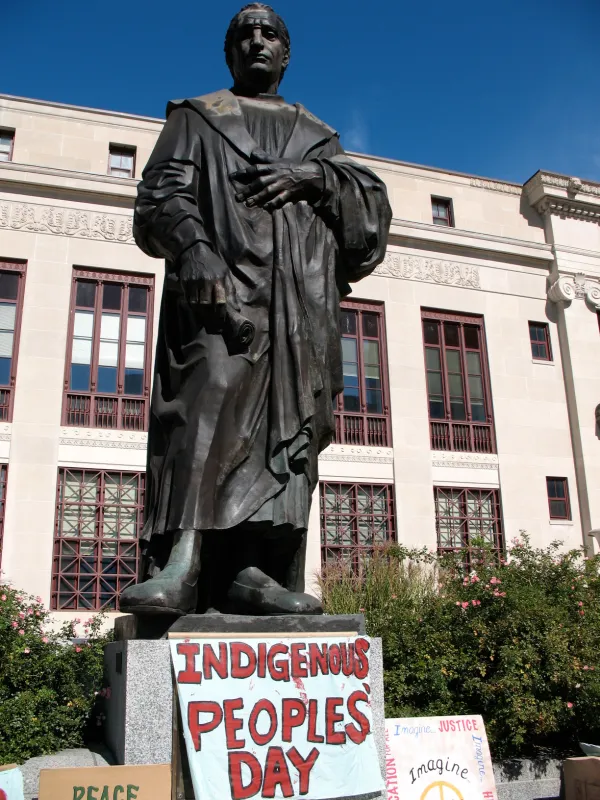
Monday was Columbus Day all across the nation. Perhaps this is a good time to reflect on the real legacy of that conquistador. As James Baldwin once put it, “What passes for identity in America is a series of myths about one’s heroic ancestors.”
One of the best ways to reconsider Columbus is to read the diaries of Columbus and Bartoleme de Las Casas. Las Casas’ extensive writings, including his most famous – “A Short Account of the Destruction of the Indies” – gives us insight into the namesake of our city.
Here’s the good Friar Las Casas' summary of Christopher Columbus’ activities in America: “What we committed in the Indies stands out among the most unpardonable offenses ever committed against God and mankind and this trade [in Indian slaves] as one of the most unjust, evil, and cruel among them.”
I know what you’re thinking. Just because Columbus was the creator of the slave trade in America, doesn’t mean he wasn’t a pretty good darn navigator.
The government shutdown engineered by the Republican tea party zealots in the House of Representatives is headed into its third week. The damage is spreading. Infants go without nutrition. Children are locked out of pre-school programs. Scientists are losing support and locking up labs.
The people taking the biggest hit, of course, are public employees — the workers who serve the American people. Some 800,000 of them were initially furloughed without pay. Ironically, those deemed the most essential are paying the highest price.
“Essential” government employees are now, as Jeffrey David Cox, the president of the American Federation of Government Employees, told me on my radio show, essentially “indentured servants.” They’re forced to work without pay. About half of AFGE’s 670,000 members are deemed “essential.” They are required to work, and face disciplinary action if they don’t. But they aren’t getting paid and won’t be until the shutdown ends and Congress decides to vote them retroactive pay.
The people taking the biggest hit, of course, are public employees — the workers who serve the American people. Some 800,000 of them were initially furloughed without pay. Ironically, those deemed the most essential are paying the highest price.
“Essential” government employees are now, as Jeffrey David Cox, the president of the American Federation of Government Employees, told me on my radio show, essentially “indentured servants.” They’re forced to work without pay. About half of AFGE’s 670,000 members are deemed “essential.” They are required to work, and face disciplinary action if they don’t. But they aren’t getting paid and won’t be until the shutdown ends and Congress decides to vote them retroactive pay.
This article is excerpted from the new book War No More: The Case for Abolition.
In the late eighteenth century the majority of people alive on earth were held in slavery or serfdom (three-quarters of the earth's population, in fact, according to the Encyclopedia of Human Rights from Oxford University Press). The idea of abolishing something so pervasive and long-lasting as slavery was widely considered ridiculous. Slavery had always been with us and always would be. One couldn't wish it away with naive sentiments or ignore the mandates of our human nature, unpleasant though they might be. Religion and science and history and economics all purported to prove slavery's permanence, acceptability, and even desirability. Slavery's existence in the Christian Bible justified it in the eyes of many. In Ephesians 6:5 St. Paul instructed slaves to obey their earthly masters as they obeyed Christ.
In the late eighteenth century the majority of people alive on earth were held in slavery or serfdom (three-quarters of the earth's population, in fact, according to the Encyclopedia of Human Rights from Oxford University Press). The idea of abolishing something so pervasive and long-lasting as slavery was widely considered ridiculous. Slavery had always been with us and always would be. One couldn't wish it away with naive sentiments or ignore the mandates of our human nature, unpleasant though they might be. Religion and science and history and economics all purported to prove slavery's permanence, acceptability, and even desirability. Slavery's existence in the Christian Bible justified it in the eyes of many. In Ephesians 6:5 St. Paul instructed slaves to obey their earthly masters as they obeyed Christ.
October is National Kink Month as declared by JT Stockroom and The Pleasure Coach, both of Los Angeles.
They define it as “Kink Month is a public education campaign – but one that appeals as much to seasoned BDSM players looking to extend their repertoire as it does to beginners curious about incorporating fetish roleplay into their love life.”
Image

Oct 11 is National Coming Out Day, and to all those who have recently or are about to come out, welcome. Please step up to claim your toaster ovens.
With Linda’s beautiful story, we launch our coming out series. We invite you to share your own coming-out stories, whether they’re funny, painful, happy or heart-breaking. We’ll post them on outlookcolumbus.com and create a space on our website where they’ll be archived as a coming-out resource.
Image

I have a crystal ball in front of me, and I’m gazing deeply into it. I’m seeing a future, one that is bright, yet has a common feel. One that seems unfamiliar, yet refreshingly new. I’m seeing a vibrant cannabis marketplace.
Cannabis-based goods and services are being exchanged between buyers and sellers for a price, much like other products. Entrepreneurs are establishing companies that make their wares available for purchase; consumers are perusing these offerings and buying the ones that fulfill their particular need at the time. The market is regulated to ensure a level playing field, but success or failure is determined by market forces like solid business plans, supply and demand - not the blunt end of a battering ram or a cash-only black market profiteer.
There has been an evolution among the five medical marijuana ballot initiatives fielded in Ohio over the past five years, with the most recent one, the Ohio Cannabis Rights Amendment, quickly gaining speed as its aims for the 2014 ballot.
I've said before to anyone who will listen (i.e. no one in particular), that history is a function of will as much as it is anything else. The ultimate will over which we struggle is that of the will of the people. And it is the will of the people that any and all protests seek to demonstrate. Of the two rallies that took place at the statehouse last Wednesday on October 2, which one better represented the will of the people? Ain't No Love reports, and will also decide.
Activism is a funny bird. By the time this prints, the government will still probably be shut down. In a parallel universe, this would be a mitzvah. I will admit that I have chanted “We're gonna rise up, we're gonna shut it down” quite a number of times at demonstrations. But this isn't that parallel universe, and so instead, the federal government shutdown and the Tea Party saga are rather instructive lessons on the limits of populist activism.
For the purposes of analysis, let us accept that the Tea Party is/was a movement that contained significant amounts of Astro-turf, but arose out of real popular discontent. To topple a structure, you need people pushing on the inside and the outside.