As the country prepares for the third anniversary of the conflict in Iraq, scores of people poured into a town hall meeting in Charlottesville on Monday in protest of a war that polls show is losing the support of the American public.

“We must impeach [President] Bush, not because he is incompetent, but because he is a danger to the world,” said David Swanson, a Charlottesville resident who co-founded the After Downing Street anti-war coalition and serves on several anti-war committees.

Swanson was one of seven people who spoke to the packed audience at McLeod Auditorium in the University of Virginia School of Nursing as part of a panel sponsored by the Charlottesville Center for Peace and Justice.

Congressional candidate Al Weed, a veteran who staunchly opposes the war, was the first to address the crowd. “We have to understand that these soldiers are doing their job whether or not we approve of it,” Weed said. “It is we who failed in sending them there.”

Coverage and analysis of the recent Hamas victory in the Palestinian parliamentary elections has been prolific. Most coverage, however, fails to look at this event in a broad historical context, as one of many features of the political and cultural landscape, and in so doing misses important elements of the message sent by Palestinians to their leadership, the international community and international civil society.

This election is one representation of the Palestinian unequivocal rejection of Israel's colonial and racist project of force-creation of a state exclusively for people of Jewish descent, not for the humans living within its borders or directly under its occupation. The reaction against this fundamental construct takes many forms, there are many different targets, but all those are borne from this fundamental fact.

The resistance against Israel's colonial-racist project was a vote for Hamas and against the Fatah-led Palestinian National Authority. The Fateh-led PNA had become both a prisoner and indispensible partner in a 'peace process' which served only to further Israel's colonial-racist project in historic
AUSTIN, Texas -- It's hard to keep up with George W. Bush's shuttles between internationalism and isolationism. You may recall he first ran for office declaring he was against nation-building and other such effete, peacekeeping efforts. None of that do-gooder, building-a-better-world stuff for him -- he couldn't even be bothered to learn the names of the Grecians and Kosovians.

Until Sept. 11, except for staring deep into Vlad Putin's ice-blue eyes and concluding the old KGB shark had soul, Bush evinced little interest in foreign affairs.

Then he literally became an internationalist with a vengeance. Absolutely everybody signed up to help go after al-Qaida in Afghanistan -- offers of help gushed in. Next came the campaign to bring down Saddam Hussein because he had weapons of mass destruction, including a nuclear weapons program. Unfortunately, most of the rest of the world didn't think Iraq had much in the way of WMD, or at least felt the United Nations inspectors should be given more time to see if they were there.

I can’t get Three 6 Mafia’s Academy Award winning lyrics out of my head: “You know it’s hard out here for a pimp. When he tryin’ to get this money for the rent. For the cadillacs and gas money spent.”

And every now and then, keeping the same beat with the same mood, thinking of pimp and pimping in a non-sexual way, with the pimp being the president of the USA, I find myself also humming and singing,: “And you know it’s hard out here being pimped. And our pimp don’t have to worry ‘bout his rent. He gets a nice per cent of gas money spent.”

Thank you, thank you, thank you for your publication and for the persistent, committed work of Bob Fitrakis and Harvey Wasserman.  If we ever have an election system in which we can believe, we will owe much to these two gentlemen.  Also, the National Voting Rights Institute, and Black Box Voting.  You are harbingers of hope.  Keep up your good work!

Carol Harkins
Tulalip, WA 
Washington, March 14 -- Last Wednesday evening, the House Appropriations Committee voted to throw another $67,000,000,000 at the murderous work in Iraq and Afghanistan. That night members of the committee, righteously indignant and nearly unanimous, gave President "Bring ‘Em On" Bush a loud slap in the face.

Whoa! You mean the most powerful committee in Congress voted 62-2 to stop funding our national war crimes orgy? Of course they did…and then we all lived happily ever after.

No, the killing will proceed as planned, with no congressional intervention, although chances are you heard absolutely zip about the 67 Billion Dollar Question, thanks to the Guardians of Reality who insured the news from that hearing was the Dubai Port deal, not the unimaginable sum of our money Congress voted for war, nor the voices raised against it.

That news must come from places like the internet site you’re now reading, not the corporate press. And I’m here to tell you the story.

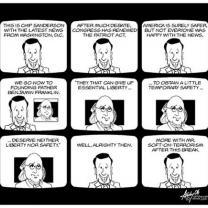
Foreign policy, legal and human rights authorities are raising serious questions about the credibility of the U.S. State Department’s annual report on human rights, released last week.

The response of Noah S. Leavitt, an attorney who has worked with the International Law Commission of the United Nations in Geneva and the International Court of Justice in The Hague, is typical. Leavitt said, "The sad reality is that because of the Bush Administration’s haughty unilateralism and its mockery of international prohibitions on torture, most of the rest of the world no longer takes the U.S. seriously on human rights matters.”

While most of the experts contacted find little fault with the accuracy of the report, they question whether U.S. human rights abuses committed in the “Global War on Terror” have diminished America’s authority to speak out on this issue.

Pages

Subscribe to Freepress.org RSS