
Global

The continuing rise of fascism around the world is drawing increasing attention particularly as it takes firmer grip within national societies long seen to have rejected it.
Some recent studies have reminded us of the characteristics of fascist movements and individuals, particularly as they manifest among politically active fascists. For example, in his recent bookHow Fascism Works: The Politics of Us And ThemProfessor Jason Stanley has identified ten characteristics shared by fascists which have been simply presented in the article ‘Prof Sees Fascism Creeping In U.S.’

According to the analysis of police-murder-instigator Dave Grossman, the reason that only a minority of soldiers attempted to kill in World War II and earlier wars was a general aversion to committing murder. And the reason that the vast majority of U.S. soldiers (marines, sailors, etc.) have attempted to kill in recent decades is “classical conditioning.” A fireman rushes into a fire without thinking, if he or she has been conditioned through drill repetition to do so. Soldiers kill without thinking, if they have been trained to do so through the repetition of the realistic simulation of killing.

When I say there is nobody to vote for, I don’t just mean the familiar complaint that the candidates may be different shades of evil but are all too evil to support, that the earth’s climate does not recover one iota because some even worse policy has been averted, that sadistic bombings and humanitarian bombings actually look identical. I do mean all of that. But I also mean that candidates are campaigning as and being presented as nothing, as empty figures with no positions on anything.
What is the most common foreign policy position on the websites of Democratic candidates for U.S. Congress? Quick! It’s not hard! You got it? You’re wrong. It was a trick question. Most of their websites do not admit to the existence of 96% of humanity in any way shape or form — although one can infer that the world must exist, because so many of them express such deep love for veterans.

Donald Trump's ties to the Russian mafia -- and his ability to launder money for them via various properties -- goes back at least 35 years, according to the investigative author of a new book.
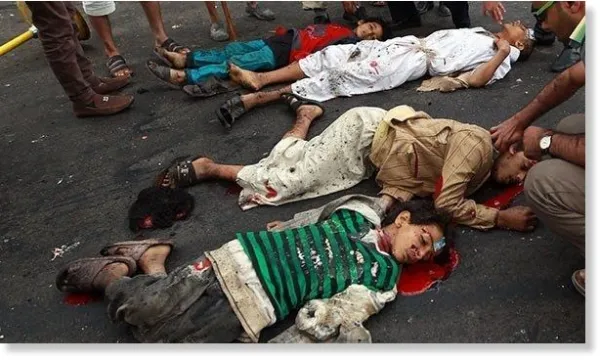
What would it take for everyone’s life to matter as much as Jamal Khashoggi’s?
I ask this question over at the edge of the news, looking for a doorway into the human conscience.
Consider:
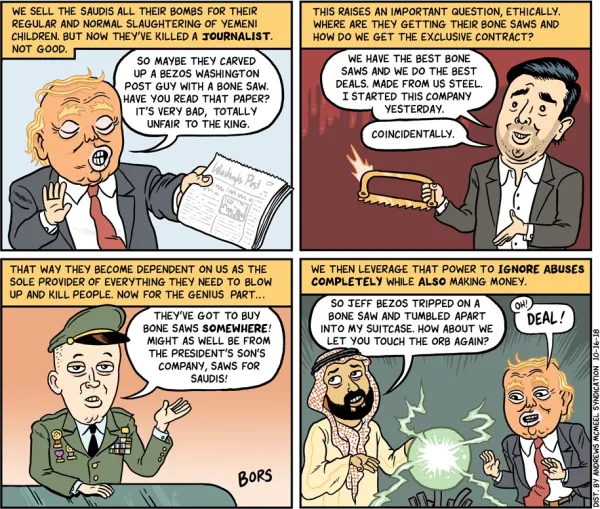
“The U.S. sold a total of $55.6 billion of weapons worldwide in the fiscal year that ended Sept. 30 — up 33 percent from the previous fiscal year, and a near record. In 2017, the U.S. cleared some $18 billion in new Saudi arms deals.”
This is from CBS News Moneywatch two weeks ago. No big deal, just a look at the U.S. weapons biz, which has been thrust into the national spotlight recently.

It’s time the world at long last learns the truth—-one way or the other—-about Stormy Daniels vs. Donald Trump.
A single intimate drawing of the nation’s “First Member” could end it all.
This bitter controversy has spread all the way through the court system to Stephen Colbert ( https://www.youtube.com/watch?v=YRhcYTidHik ) , and has become an international embarrassment to our Puritan nation.
Ms. Daniels claims she had a brief but intimate affair with Trump just after his youngest son was born to his current third wife, the First Lady.
In her new memoir Full Disclosure, Stormy describes the First Member as “smaller than average” with a “huge mushroom head…like a toadstool.”
“I lay there,” she writes, “annoyed that I was getting f***ed by a guy with Yeti pubes and a d**k like the mushroom character in Mario Kart.”
Stormy claims their sexual encounter was, to put it politely, brief and unsatisfying.
Trump says it never happened.

– Jamal Khashoggi’s column lede, Washington Post, September 11, 2018

This whole two-week effort has been a calculated and orchestrated political hit, fueled with apparent pent-up anger about President Trump and the 2016 election, fear that has been unfairly stoked about my judicial record, revenge on behalf of the Clintons and millions of dollars in money from outside left-wing opposition groups.
 he integrity of the US judicial system is actively, albeit quietly, in play. A sitting federal judge, or more likely a panel of sitting federal judges, will be required in the near future to render an assessment of the honesty, integrity, and fitness of a Supreme Court justice to retain his lifetime appointment. The process and the result of the federal judges’ decision will, together, render a judgment as to the integrity of not just one Supreme Court justice but the federal courts as a national institution.

Originally published at the Nation Magazine: https://www.thenation.com/article/democratic-autopsy-one-year-later/