
Global
Oliver Stone’s 2012 thriller Savages opens with gorgeous coastline images accompanied by O or Ophelia’s (Blake Lively) voiceover saying: “It started here in paradise, Laguna Beach, where they say God parked himself on the seventh day…” In addition to its stunning scenery, languid Laguna has much to lure Angelenos away from the big city’s daily grind to this SoCal oceanic enclave located about 50 miles south on the 5 Freeway from Downtown L.A.
Of course, this Orange County seaside village is widely known for its art galleries - and it’s no wonder, given the splendor of its natural surroundings that would make any dauber’s palette burst with color. But there are also eateries there to make gourmet’s palates drool, so I decided to combine one of my regular excursions as a theater reviewer south to the Laguna Playhouse with a feast.
Drifting Down to Driftwood Kitchen: Caramel-By-the-Sea
Enough is enough. Especially when it comes to a name.
Many of you have undoubtedly faced a crisis or two about your own. It can come from anywhere, like changing (or NOT) your family name when getting married. Or dumping the curse of one you never liked.
Famous examples abound. The great Texas-born classical pianist Van Cliburn was in fact Harvey Lavan Cliburn. Lady Gaga is Stefani Joanne Angelina Germanotta. Kirk Douglas was Issur Danielovitch. Marilyn Monroe came from Norma Jean Mortenson. Tony Curtis had been Bernard Schwartz. John Wayne was Marion Mitchell Morrison.
You get the picture.
When I was born in Boston 72 years ago this New Year’s Eve, my mom made my father promise not to name me “Harvey.” Dad’s father, who’d just passed away, was Herschel. So the “H” was unavoidable. But there were certainly better choices. She never forgave him. Me either.
My middle name is Franklin, as my parents were big FDR fans. As an historian, I like it for Ben.
Wasserman means “Aquarius” or Water Man in German. I’m good with that.
But “Harvey”?

Is Santa real? What about God? Or Mr. Stranger Danger? A 5-year-old’s curiosity is a wonder to behold — more than a wonder if you haven’t had your coffee yet, or if you’re trying to get last-minute Christmas shopping done at Target and your son says he wants to die right now so he can meet God.
To be a parent is to feel the force of this curiosity like a live spring uncoiling with unpredictable energy against the day’s agenda and the furthest reaches of the known universe, pushing you into a possible future not yet imagined.
“When did people first realize there was a God?”
This is my great-nephew Jackson, doing curiosity handsprings across the academic discipline of theology and squeezing an open-mouthed pause from his mom, Carmen, my niece — with whom I had a lively chat over the holidays about such matters when she had a moment to relax. This was a conversation of puzzlement and gold, and I’ve been thinking ever since about childhood and the precious possible.

He was “a good and decent man, who saw wrong and tried to right it, saw suffering and tried to heal it, saw war and tried to stop it.” – Ted Kennedy, eulogizing his assassinated brother Bobby in 1968
“The problem with a mass delusion is that, by definition, only the heretics know when we are living through one.” – Michael Scott Fontaine
One of the most meaningful Christmas stories that I have ever read came from my friend from Vancouver, Canada, Reverend Kevin Annett. His story is titled “Nativity” and is printed further below. “Nativity” has as much meaning to me as have the classic Christmas movies “It’s a Wonderful Life”, Charles Dickens’ “A Christmas Carol”, and “Joyeux Noel” (the story of the Christmas Truce of 1914). (Archived at: http://duluthreader.com/articles/categories/200_Duty_to_W.)
Good things and bad things happen daily here. Daily we get to meet great
visitors and work with great volunteers and staff that are making amazing
progress on the Palestine Museum of Natural History and the botanical
garden (palestinenature.org). We received good news on some grants and
submitted several others just in the past two weeks and got three more
research papers submitted and two more accepted. But politics keeps sending
us bad news. Tribalism and nationalism are rearing their ugly heads and
people suffer.
The people of the world are waking up despite the fact that most mainstream
media is now "managed" to give that Zionist message of danger from Iran,
Hizballah etc while ignoring war crimes and crimes against humanity being
perpetuated daily by Israel and its puppets like Mohammad Bin Salman. What
[NOTE: This review may contain plot spoilers.]
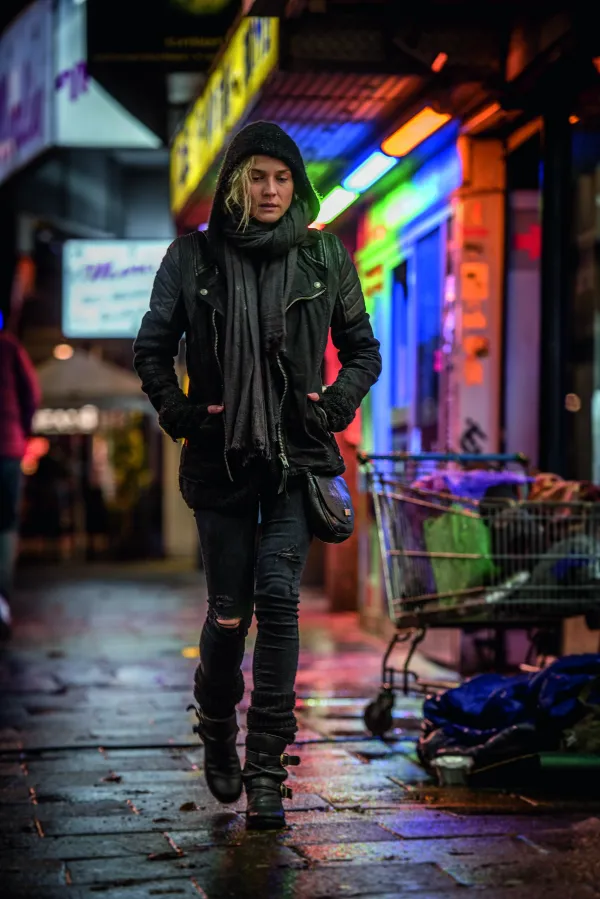
I never fail to be astonished at how the arts, as Shakespeare put it, hold a mirror up to nature, that is, to our society and current events. As the rightwing anti-immigrant, anti-Muslim tide rises, with its ripped-from-the-proverbial-headlines vibe, In the Fade (Aus dem Nichts) is a case in point. This German neo-nazi drama written and directed by Turkish-German auteur Fatih Akin’s (Head On, Soul Kitchen, The Edge of Heaven) is extremely timely.

News gets more bizarre every week. It was revealed that Mohammad (Kushner)
Bin Salman has spent a billion dollars to buy a home in France and one
Leonardo da Vinci painting and another half trillion dollars buying weapons from
US Corporations (whose only use will be to kill more Yemeni civilians).
More bizarre for me was that Mahmoud Abbas dutifully condemned the rocket
fired from Yemen in self-defense after Saudi Jets have dropped tons of US
and British bombs on Yemeni cities. Then we hear the Zionist puppets
Nimrata Randhawa (who changed her name to Nicki Haley) and the (orange)
bully Trump threaten countries who were about to vote at the UN based in
support of international law (which says Israel is an occupying power in
Jerusalem). Despite these bizarre threats, 128 countries voted with, 9
against, and 35 (shamefully) abstained (those who did not vote with
international law should be held accountable by their people so please
check how your country voted and challenge them). Nimrata and the Orange
puppets were really angry!! Their bosses in Tel Aviv were acting their

 n December 6, a majority of Democrats in the House joined all House Republicans in voting to prevent the House of Representatives from even debating articles of impeachment against President Trump. The House voted 364-58 (with 10 non-votes) to table impeachment articles (H RES 646) sponsored by Texas Democrat Al Green. Over the strong objections of Democratic leaders (an oxymoron), Green had brought his impeachment resolution to a vote by invoking his personal privilege as a House member. Green’s resolution began:

The most recent claim that Russian President Vladimir Putin is “running” Donald Trump as if the U.S. president is a Russian intelligence asset comes from former Director of National Intelligence (DNI) James Clapper. “[Putin] knows how to handle an asset, and that’s what he’s doing with the president,” Clapper told CNN last Monday.
Clapper, who served as DNI under President Barack Obama, and who has repeatedly disparaged Trump both before and since the 2016 election, called the Russian president a “great case officer,” which might be the only nice thing said about Putin by a former senior U.S. official in quite some time.
Clapper was asked by CNN’s Jim Sciutto, “You’re saying that Russia is handling President Trump as an asset?” He responded “That seems to be... that’s the appearance to me.” Later in the conversation, Clapper backtracked slightly, clarifying his remarks by adding “I’m saying this figuratively.”