Global
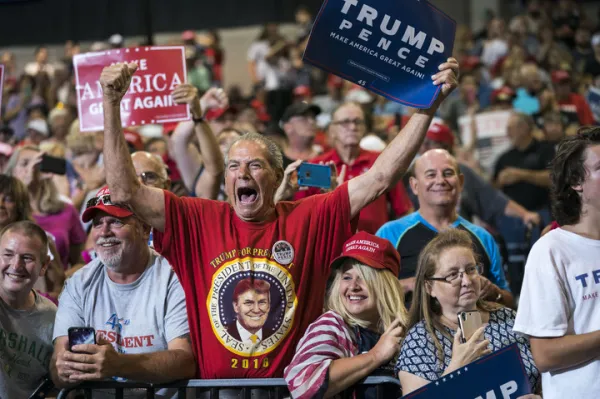
Ok, let’s dismiss the continuing fantasy that Donald Trump is the president of all Americans. He’s not. And he’s never going to be. He is the president of the United Base of America.
The conventional wisdom is that during the primaries candidates appeal to the extreme wing of their party and then move to the center in the general election campaign. Trump re-wrote that playbook. He was elected by his base, he continues to play to his base and the only Americans he gives a shit about are his core Trumpsters. The base. The 30% who, as Trump himself bragged, would still support him even if he shot someone in the middle of New York’s 5th Avenue.
So we should stop expecting the Trump pivot. It’s never coming. He’s never going to become “presidential.” He’s never going to be the president of all Americans. He’s never going to unite. He will continue to divide. To pit his rabid, vapid hate-filled base against everyone else. Against logic, facts and rational thinking.
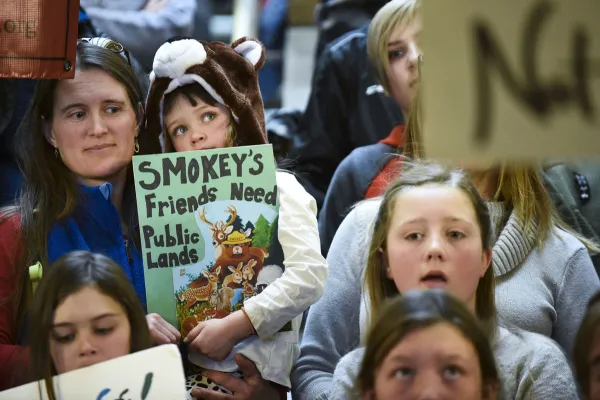
My wife and I recently ventured from our home in Montana on a two-week road trip to the Southwest. The excursion took us deep into Utah’s majestic canyon country and the West’s ongoing clash over our federal public lands, a conflict most recently inflamed by Interior Secretary Ryan Zinke’s recommendation to shrink a number of our National Monuments. While the environmental, social, and political issues around these fights remain contentious, one thing has become clear: Strong public lands protections fuel thriving economies.
Yes, of course, every day that Congress goes on refusing to ban guns is more blood on the steps of the U.S. Capitol. It’s immoral, disgraceful, embarrassing, and in large part a function of financial corruption. But it’s also in part a government operating within a culture of violence — albeit one that the same government plays a huge role in creating.
U.S. movies, tv shows, video games, music, news, and schools are uniquely and increasingly violent. Primates’ chief form of behavior is imitation. Humans are no exception to that rule. Human cultures that have not known stories of mass-murder have also not known mass-murder. Anthropologists have studied cultures in which people have had an absolute taboo on taking human life.
U.S. culture floods us with the acceptability of violence. Check out Heidi Tilney Kramer’s Media Monsters: Militarism, Violence, and Cruelty in Children’s Culture for a catalogue of horrors that extends from the normalization of torture in G-rated movies to the celebration of war in song lyrics. Kramer quotes some experts:

In the wake of the Las Vegas massacre, as in the wake of all the high-profile mass shootings that preceded it, the big question looms: Why?
John Whitehead puts the question this way: “What is it about America that makes violence our nation’s calling card?”
This is the enormous question — you might call it the $700 billion question, which is the size of the 2018 military budget recently approved by the Senate — that most media and law enforcement personnel do not ask or acknowledge, as they search for clues about the motive behind Stephen Paddock’s rampage on the night of Oct. 1 amid the scattered wreckage of the killer’s life.
He was a “lone wolf.” He was a “psychopath.”
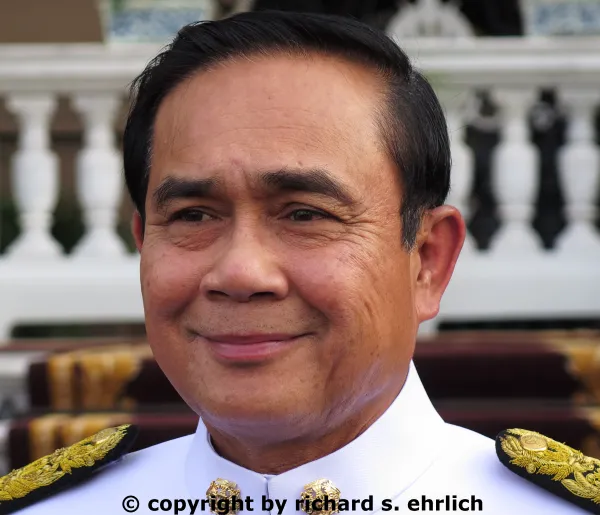
BANGKOK, Thailand -- President Donald Trump's White House invitation to meet Thailand's Prime Minister Prayuth Chan-ocha on October 2 allowed Bangkok's coup-installed military government to gain prestige and legitimacy while the junta's political opponents are fearful, muzzled and without a strong leader.
"Prayuth and the generals crave legitimacy, particularly from the U.S. and E.U. who have criticized revolving-door coups and governments in Thailand over the past 10 years," Paul Quaglia, a former C.I.A. officer in Bangkok, said in an interview.
"The U.S. press corps, unrestrained by Thai military censorship and hostile to a Trump administration, is likely to raise embarrassing questions about...palling around with coup-sponsoring generals," said Mr. Quaglia, 68, who is now the Bangkok-based director of PQA Associates, a private security concern in Hong Kong.
"President Trump looks forward to reaffirming the relationship between the United States and a key partner and longstanding ally in Asia, the Kingdom of Thailand," the White House said September 25.
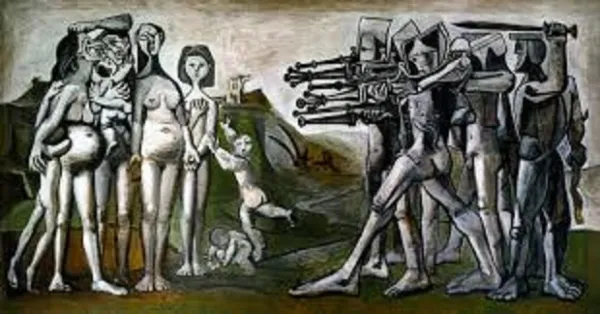
“Peace” clubs in U.S. schools are likely to teach that a local bully is afraid and in need of help. They are much less likely to teach that about entities involved in the actual subject of peace (meaning the absence of war), such as — to take the example momentarily most prominent in U.S. propaganda — North Korea.
“Ignorance about the Korean war,” writes Blaine Harden, “has . . . led to the cartoonish ahistorical understanding many Americans still have of contemporary North Korea. They know that a family of clownish-looking dictators named Kim has created a hermit state armed with nuclear weapons. They know that it is wildly belligerent toward the United States. But most do not know that the fears of North Korea’s isolated citizens are firmly rooted in history: they are afraid that Americans might once again raze their country. Thanks to the bombs and napalm dropped by the U.S. Air Force during the Korean War, the Kim family is able to stoke anti-American hatred and perpetuate its rule, all while telling a terrifying, fact-based story that most Americans have never heard.”
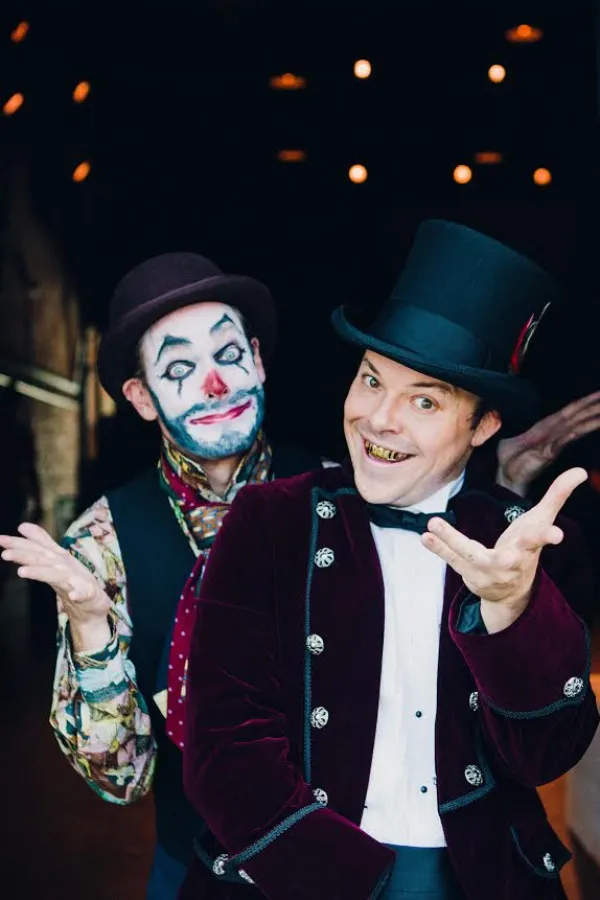
Gordon Gekko may have articulated the Reagan era’s ethos when he proclaimed “Greed is good” in Oliver Stone’s 1987 Wall Street, but in terms of ethics Captain Greedy is not good - although when it comes to sheer showmanship and moral musings, The Actors’ Gang grabs the brass ring and hits a bull’s eye with Captain Greedy’s Carnival.
The first act of Captain Greedy’s Carnival, with its book and lyrics by Jack Pinter and music by Roger Eno, is an exceedingly clever concoction combining the free market philosophy of economists such as Smith, Hayek and Friedman with the format of a carnival. Capitalism is insightfully compared to a carnival’s games of chance. Through this circus-like atmosphere the co-creators, their cast of about 20 performers (The Gang’s all here!) plus a live band lampoon laissez faire economics with a humorous harpoon, its razor sharp tip dipped in acid.

For the first time in 12 years (or longer, if you’ve forgotten Enterprise existed), there’s a new Star Trek series. Set about a decade before the original series, Star Trek: Discovery follows a Black woman captain (angering people who have apparently never watched Star Trek and aren’t aware that it’s been about social justice since 1966) as she navigates the early days of the war between the Klingons and the Federation. It’s the first post-J.J. Abrams Trek show, and fans are excited to step away from the new movie universe and revisit the original series’ timeline.
But regardless of whether the show turns out to be the next The Next Generation or just another Enterprise, it’s already being hobbled by one huge problem: CBS is only making it available in the US through their “All Access” streaming service.
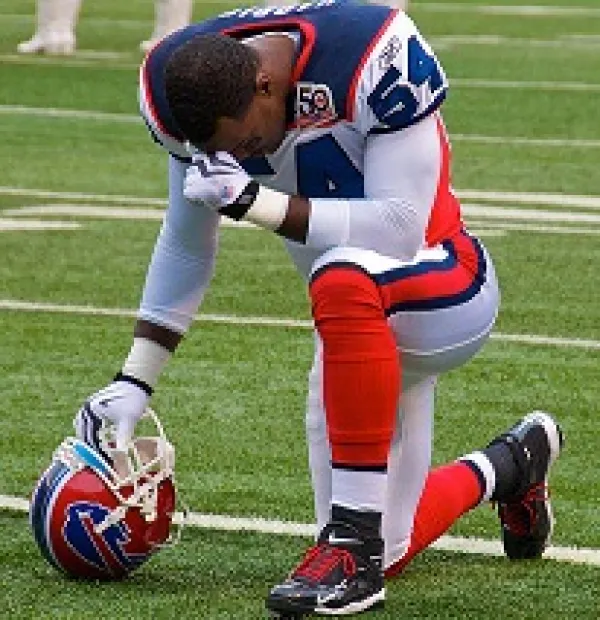
Well, our President in Twitter Chief, Donald Trump, has once again trumped his own self. This time he’s taking on the rights of athletes to protest the injustices inflicted on people of color in America during NFL games. Our Twitter Chief, President Trump, feels that it’s more important for him, as President of the United States, to tweet about the right for people to protest peacefully, than it is for him to tweet about the horrific plight of the people of Puerto Rico, who are in desperate need of drastic help to rebuild and survive after hurricane Maria.
As of September 27, our Twitter Chief had tweeted twenty-three plus times about his anger at the NFL players for not “standing and being respectful during the national anthem” and only six times about how he was going to help Puerto Rico, which by the way is a part of the United States since 1898, which makes the people of Puerto Rico AMERICAN citizens. But wait a minute, hold up, seems like we have been down this road before with the President of the United States being slow to help its “Brown” American citizens after a natural disaster.