
Global

The flag in front of Home Depot was at half-mast and I felt myself wondering why in an awkward, despairing way.
The nation and the news cycle were still thrashing in the wake of the Chattanooga killings and I figured, oh, it’s for the soldiers — but all that realization did was intensity the troubled feelings the spectacle had aroused. This is America, where you can shop and mourn . . . but it wasn’t just that.
I suddenly thought about Sandra Bland’s apparent suicide in a Texas jail cell and, from there, I thought about a year’s worth of video footage of racism-scarred arrests and violence and, beyond that, the brutal stupidity of the wars we wage and two dozen or more vet suicides every day — this was all in the space about 20 seconds, while I was parking my car — and by the time I reached the entrance of the big box, I found myself asking: Why should the flag ever NOT be at half-mast?
And that was just the beginning. The flag, the flag . . .
Maybe it’s part of the problem.
Acting Costa Rican President José “Don Pepe”Figueres Ferrer takes a sledgehammer to the Cuartel Bellavista military barracks, 1948
The 22 countries which have abolished their militaries or were founded without one are uniformly tiny, isolated, and often island nations. In many cases, these states maintain national police or paramilitary forces for internal protection (some might say from their own citizens in the event of a popular uprising to effect regime change), maritime defence patrols, or are defended by their former colonial masters. Some might say they are at little risk of invasion because there’s nothing more to take and few to fight back!
Although countries with armies may be more complex and have extensive economic and foreign policy agendas, there is no reason why they, too, could not take the first step in abolishing their large and costly militaries. One country’s standing army can only be an implied threat against other nations. When a country has an army, there is every incentive to put it to aggressive use.
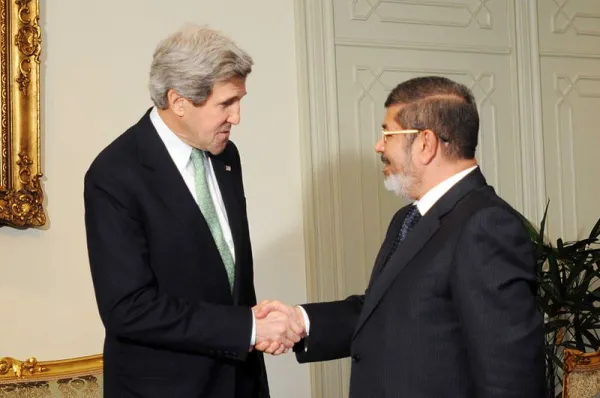
Message to The United Nations, European Union, United States, and all Democratic and Free countries
There are growing concerns that the government of Egypt intends to execute Egypt’s first ever democratically elected President, Mohamed Morsi in the coming weeks. Mr. Morsi along with hundreds of political opponents received the death sentence following what major international human rights organizations described as a hopelessly flawed and politically motivated trials that ignored acceptable minimum international standards.
President Morsi was ousted during the illegal military coup led by the then Defense Minister Abdel Fattah el-Sisi, and has been imprisoned ever since. President Morsi’s death sentence and the impending execution of countless others (students, women, religious scholars, politicians, and academics)involved in working for democracy in Egypt presents a sobering example of the escalating violence and continual human rights abuses perpetrated against the Egyptian people since the Fourth Anniversary of the January 25 Egyptian Revolution earlier this year.

There is much that is revolting about the current world and Andre Vltchek, Christopher Black and Peter Koenig are well placed to document it, which they have done in their new book 'The World Order and Revolution! Essays from the Resistance'. http://badak-merah.weebly.com/the-world-order-and-revolution.html

Israel is trying to expel the population of a village for the crime of not being Jewish, the same crime for which Israel bombs the people of Gaza for a month or so every few years and blockades them in between these bursts of violence.
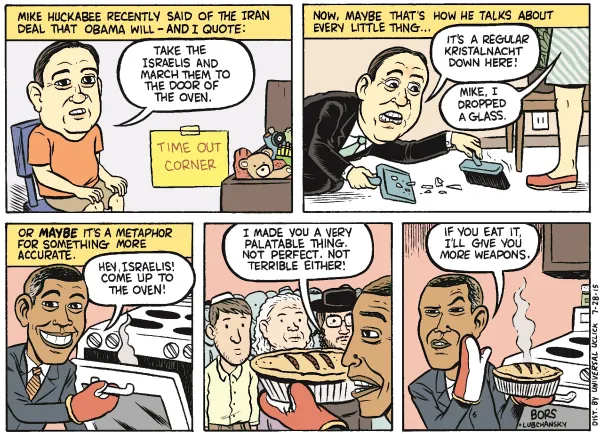
Meanwhile, Mike Huckabee declares that making peace with Iran amounts to marching Israelis "to the door of the oven."
Guess which of the two stories will get more coverage!
A crime of over 70 years ago, part of a war that in my unscientific estimate forms the single most common theme of U.S. historical fiction -- whether print or film -- is more important news in the view of U.S. editors than is a crime of right now.
And that was true 60 years after World War II and 50 years after and 40 and 20 and even 3 years after World War II.

Incredibly, in the 21st-century, roughly half of the world’s nation-states practice military conscription. According to Wikipedia, the countries on this list may still be enforcing military conscription.
In all cases, registration is required but military service may not be; this practice would certainly yield a number of draft refusers. In some cases, other forms of national service are compulsory which also generate principled refusal.
Starred * countries list provisions for alternative service or conscientious objection which exemption would also result in absolutist refusers; in some cases, the right to conscientious objection is constitutional. Failure by governments to provision conscientious objection or alternative service contravenes United Nation conventions, the Universal Declaration of Human Rights (Article 18) and the International Covenant on Civil and Political Rights (Article 18), to which almost all these nation-states are party.

Israel Lobby group AIPAC has announced the creation of a new group to lobby against the Iran nuclear deal. Dubbed “Citizens for a Nuclear Free Iran,” which intends to launch a $20 million media campaign to convince the American public that the deal is “dangerous.”
 AIPAC officials say that the group is “dedicated to preventing Iran from obtaining nuclear weapons capability,” and the campaign will be using targeted advertisement in somewhere from 30 to 40 states.
“The Americans have taken the Shia Muslim side in the Middle East’s sectarian war,” declared Robert Fisk in the “Independent” newspaper on July 15, a day after the US and five major world powers reached a landmark agreement with Iran about its nuclear programs.
Fisk’s proclamation is quite cursory. Aside from the fact that he is accepting the premise that the war in the Middle East is essentially sectarian, he implies that the Americans are purposely facilitating their policies based on sectarian agendas. They are not.

Jon Stewart interviewed President Obama for the last time and told jokes instead of asking questions.
If Stewart retires, where will we find someone willing to let Obama spew nonsense at such length unchallenged?
I discussed Obama's interview on RT on Wednesday, and someone asked me to post the Youtube, but RT has to do that, not me. So here's the gist of what I think.
Stewart said to Obama: you've tried bombing and overthrowing leaders and arming rebels and ... what's that new thing ... oh yeah, diplomacy.
Everybody laughed.
Obama talked up the Iran deal.
Stewart should have asked Obama a question, such as, "If you prefer diplomacy in this case, why not in many other cases where you seem to prefer war?" He could have followed up by asking about each war.