
Human Rights
With the closing of American embassies across the Middle East and Africa, the latest terror threat emanating from Yemen is severe enough to give U.S. security officials pause. In the meantime, as many people curiously seek out Yemen on a world map, we might ask ourselves why a terror threat this serious should arise from such a small player on the world stage. As the United States has withdrawn its troops from Iraq and plans an organized withdraw from Afghanistan, this broad security threat against American diplomatic posts seems unwarranted at the very least, and still has nothing whatever to do with Yemen.
Americans are just beginning to discover that a secret court has been quietly erasing their constitutional right to be free from unreasonable searches and seizures. They are also learning that this court is made up primarily of conservative activists from the Republican Party who have no respect for the original intent of the Constitution’s framers.
With the blessing of this secret court, the National Security Agency (and well-paid companies like Booz Allen) have recorded billions of phone calls and e-mails belonging to nearly all Americans, with the intent of searching them later.
With the blessing of this secret court, the National Security Agency (and well-paid companies like Booz Allen) have recorded billions of phone calls and e-mails belonging to nearly all Americans, with the intent of searching them later.
Like all schoolchildren in America, Congress is now on summer recess. Predictably, while unsupervised, they have taken to playground shoving and taunting in earnest. A troika of ardent NSA defenders took to the airwaves Sunday to claim that they were fully informed. Meanwhile a member of the small but growing wing of Congress with the reading comprehension skills to digest the Constitution took to social media to dispute them.
Thursday afternoon at 2:31 an email was sent to Congressional staffers through the House email system called “E-Dear Colleagues.” The system electronically mimics the old style of sending paper memos between lawmakers in what was called a “Dear Colleagues” letter. According to a staffer who was interviewed about the email, this system is high traffic and as a result is used by “less than half of Congressional staffers.” He went on to describe the email list as opt-in only by topic and “kind of spammy.” Most effective communication and appointments made between lawmakers happen through their staff schedulers.
Thursday afternoon at 2:31 an email was sent to Congressional staffers through the House email system called “E-Dear Colleagues.” The system electronically mimics the old style of sending paper memos between lawmakers in what was called a “Dear Colleagues” letter. According to a staffer who was interviewed about the email, this system is high traffic and as a result is used by “less than half of Congressional staffers.” He went on to describe the email list as opt-in only by topic and “kind of spammy.” Most effective communication and appointments made between lawmakers happen through their staff schedulers.
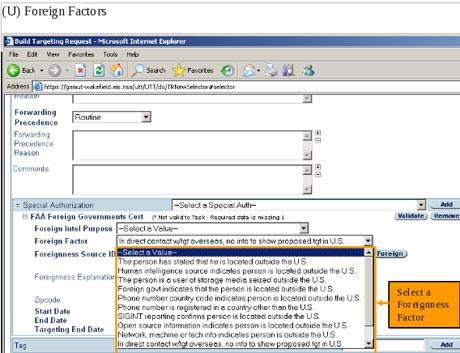
The latest bombshell revelation from Edward Snowden via the Guardian newspaper is a program called XKEYSCORE. In a previous article, the Free Press released a drop down menu that allowed NSA analysts to simply fill in the blank defining how an internet user is foreign.
Meanwhile, the redacted 32-page XKEYSCORE document proves that not metadata but content is viewed and stored. The document was created in early 2008 and claimed the NSA kept a rolling buffer for 3 days of content. The NSA has built up its storage capacity massively since then, including bringing online a huge new facility in Utah. It is not clear if XKEYSCORE now has a rolling buffer of months or years. [View Here]
Meanwhile, the redacted 32-page XKEYSCORE document proves that not metadata but content is viewed and stored. The document was created in early 2008 and claimed the NSA kept a rolling buffer for 3 days of content. The NSA has built up its storage capacity massively since then, including bringing online a huge new facility in Utah. It is not clear if XKEYSCORE now has a rolling buffer of months or years. [View Here]
Having agreed to Putin's conditions of not making additional revelations, NSA whistleblower Edward Snowden packed his bag and moved to an undisclosed location somewhere in Russia after having been granted temporary asylum. The revelations continued anyway as the Guardian released another top secret document detailing another NSA spying program called XKEYSCORE. The heavily redacted XKEYSCORE document details how the NSA searches internet users actual communications contents as opposed to metadata.
On July 26, Attorney General Eric Holder made promises to Vladimir Putin, the President of Russia via Russia's Justice Minister, Alexander Konovalov. In his open letter, Holder claimed that the United States would not execute Edward Snowden for his alleged crimes.
“The charges he faces do not carry that possibility, and the United States would not seek the death penalty even if Mr. Snowden were charged with additional death penalty-eligible crimes,” the letter stated. The letter further explains that Snowden does not face torture on American soil prior to his conviction for espionage, because “Torture is unlawful in the United States.”
The Russia government has vowed that it will not turn Snowden over to American authorities. The United States has threatened to cancel several high level diplomatic meetings over the flap. Senator Lindsey Graham (R-SC) has called for a boycott of the 2014 Olympics if Snowden is not returned. Some sources have speculated that Obama may cancel his trip to Moscow after the G-20 Summit over Russia's issuance of temporary asylum to the whistle-blower turned world’s most hunted man.
“The charges he faces do not carry that possibility, and the United States would not seek the death penalty even if Mr. Snowden were charged with additional death penalty-eligible crimes,” the letter stated. The letter further explains that Snowden does not face torture on American soil prior to his conviction for espionage, because “Torture is unlawful in the United States.”
The Russia government has vowed that it will not turn Snowden over to American authorities. The United States has threatened to cancel several high level diplomatic meetings over the flap. Senator Lindsey Graham (R-SC) has called for a boycott of the 2014 Olympics if Snowden is not returned. Some sources have speculated that Obama may cancel his trip to Moscow after the G-20 Summit over Russia's issuance of temporary asylum to the whistle-blower turned world’s most hunted man.
Army private and whistle-blower Bradley Manning was found guilty of 19 separate charges at his court martial on Tuesday. He was not convicted of the most serious charge of aiding the enemy, which carried the death penalty. The convictions include six violations of the Espionage Act of 1917. These convictions alone could cost Manning 60 years behind bars. The espionage convictions are considered especially chilling to the press, as now news “sources” can be prosecuted for much more serious charges. Taken together with the recent 4th circuit court of appeals decision against James Risen, which allows a journalist to be jailed for not revealing a source, the net effect is will be to force the press to participate in the potential life imprisonment of any person who reveals war crimes if the government classifies documents related to those crimes.
The sun rose with a moral verdict on Bradley Manning well before the military judge could proclaim his guilt. The human verdict would necessarily clash with the proclamation from the judicial bench.
In lockstep with administrators of the nation’s war services, judgment day arrived on Tuesday to exact official retribution. After unforgiveable actions, the defendant’s culpability weighed heavy.
“Our apologies, good friends, for the fracture of good order, the burning of paper instead of children, the angering of the orderlies in the front parlor of the charnel house,” another defendant, Fr. Daniel Berrigan, wrote about another action that resulted in a federal trial, 45 years earlier, scarcely a dozen miles from the Fort Meade courtroom where Bradley Manning faced prosecution for his own fracture of good order.
“We could not, so help us God, do otherwise,” wrote Berrigan, one of the nine people who, one day in May 1968 while the Vietnam War raged on, removed several hundred files from a U.S. draft board in Catonsville, Maryland, and burned them with napalm in the parking lot. “For we are sick at heart…”
In lockstep with administrators of the nation’s war services, judgment day arrived on Tuesday to exact official retribution. After unforgiveable actions, the defendant’s culpability weighed heavy.
“Our apologies, good friends, for the fracture of good order, the burning of paper instead of children, the angering of the orderlies in the front parlor of the charnel house,” another defendant, Fr. Daniel Berrigan, wrote about another action that resulted in a federal trial, 45 years earlier, scarcely a dozen miles from the Fort Meade courtroom where Bradley Manning faced prosecution for his own fracture of good order.
“We could not, so help us God, do otherwise,” wrote Berrigan, one of the nine people who, one day in May 1968 while the Vietnam War raged on, removed several hundred files from a U.S. draft board in Catonsville, Maryland, and burned them with napalm in the parking lot. “For we are sick at heart…”
When we think about a secret drone strikes, we often imagine remote and mountainous North West Pakistan, where Taliban fighters flee from neighboring Afghanistan in order to rest, recruit and regroup. Although the majority of America’s robotic death rains down there, other parts of the world are on the receiving end of this superpower’s displeasure.
Yemen is one such place. There the US supported government struggles against rebels and, according to diplomatic cables, allegedly acquired by Bradley Manning and released by Wikileaks, the Yemeni government pretends US drone strikes are its own. The puppet state imprisons journalists at the direct request of President Obama, and the military actions are approved by him at a weekly meeting that the White House staff and others call “Terror Tuesday.”
Yemen is one such place. There the US supported government struggles against rebels and, according to diplomatic cables, allegedly acquired by Bradley Manning and released by Wikileaks, the Yemeni government pretends US drone strikes are its own. The puppet state imprisons journalists at the direct request of President Obama, and the military actions are approved by him at a weekly meeting that the White House staff and others call “Terror Tuesday.”
It’s now painfully clear that the president has put out a contract on the Fourth Amendment. And at the Capitol, the hierarchies of both parties are stuffing it into the trunks of their limousines, so each provision can be neatly fitted with cement shoes and delivered to the bottom of the Potomac.
Some other Americans are on a rescue mission. One of them, Congressman Justin Amash, began a debate on the House floor Wednesday with a vow to “defend the Fourth Amendment.” That’s really what his amendment -- requiring that surveillance be warranted -- was all about.
No argument for the Amash amendment was more trenchant than the one offered by South Carolina Republican Jeff Duncan, who simply read the Fourth Amendment aloud.
To quote those words was to take a clear side: “_The right of the people to be secure in their persons, houses, papers, and effects, against unreasonable searches and seizures, shall not be violated, and no Warrants shall issue, but upon probable cause, supported by Oath or affirmation, and particularly describing the place to be searched, and the persons or things to be seized._”
Some other Americans are on a rescue mission. One of them, Congressman Justin Amash, began a debate on the House floor Wednesday with a vow to “defend the Fourth Amendment.” That’s really what his amendment -- requiring that surveillance be warranted -- was all about.
No argument for the Amash amendment was more trenchant than the one offered by South Carolina Republican Jeff Duncan, who simply read the Fourth Amendment aloud.
To quote those words was to take a clear side: “_The right of the people to be secure in their persons, houses, papers, and effects, against unreasonable searches and seizures, shall not be violated, and no Warrants shall issue, but upon probable cause, supported by Oath or affirmation, and particularly describing the place to be searched, and the persons or things to be seized._”