
Op-Ed

Jon Stewart interviewed President Obama for the last time and told jokes instead of asking questions.
If Stewart retires, where will we find someone willing to let Obama spew nonsense at such length unchallenged?
I discussed Obama's interview on RT on Wednesday, and someone asked me to post the Youtube, but RT has to do that, not me. So here's the gist of what I think.
Stewart said to Obama: you've tried bombing and overthrowing leaders and arming rebels and ... what's that new thing ... oh yeah, diplomacy.
Everybody laughed.
Obama talked up the Iran deal.
Stewart should have asked Obama a question, such as, "If you prefer diplomacy in this case, why not in many other cases where you seem to prefer war?" He could have followed up by asking about each war.
“Officials in France and in Brussels said on Monday that they were unhappy and dumbfounded with the no vote, but let it be known that they would hold the door open to the possibility of a compromise between Greece and its creditors.”
Dumbfounded? Why? Because the godlike power of the creditors was insulted?
Mainstream coverage of economic matters — the above quote is from the New York Times — seldom cuts very deep into the world of money, seldom questions who’s in charge, and seldom dares to suggest that an economic system ought to serve humankind rather than vice versa.

I just read what may be the best introduction to peace studies I’ve ever seen. It’s called Peace Lessons, and is a new book by Timothy Braatz. It’s not too fast or too slow, neither obscure nor boring. It does not drive the reader away from activism toward meditation and “inner peace,” but begins with and maintains a focus on activism and effective strategy for revolutionary change in the world on the scale that is needed. As you may be gathering, I’ve read some similar books about which I had major complaints.

At the bond hearing, grieving loved ones forgave Dylann Roof. This was reported as news, but it was so much more than that. It was the light embracing the darkness.
And white America absorbed this forgiveness through the eyes of the 21-year-old terrorist, who watched the proceedings on a video screen from his jail cell. Whatever he heard and felt is unknown, but beyond him, in the world he believed he was saving, something gave. The solidarity of whiteness — the quiet assumption of white supremacy — shuddered ever so slightly.
The flag, the flag . . .
The fate of this symbolic relic of the slave era is now the big story in the aftermath of Roof’s murder of nine African-Americans. He acted in such clear allegiance to the Confederate flag that politicians everywhere — even Republican presidential candidates — are demanding, or at least acquiescing to, its removal from public and official locations, such as in front of the South Carolina State House.
Not only that, “Walmart and Sears, two of the country’s largest retailers, will remove all Confederate flag merchandise from their stores,” CNN reported.
Last month at the graduation ceremony of Tuskegee University, a historically black college, first lady Michelle Obama spoke candidly about the racial barriers facing African Americans and encouraged them to overcome continuing discrimination by staying “true to the most real, most sincere, most authentic parts of yourselves.”
People, she said, “will make assumptions about who they think you are based on their limited notion of the world.” She and her husband have “felt the sting of those daily slights throughout our entire lives.” But “those feelings are not an excuse to just throw up our hands and give up. … They are not an excuse to lose hope.”

What does it say about America when women or men who are sexually abused or raped are then re-victimized by the public and media? Well, and I know this personally, it says to the victim, “Welcome to the second worst nightmare of your life.”
As a female combat veteran of Iraq suffering from Military Sexual Trauma or MST, I have first-hand experience with the culture of “victim blaming” or the “second assault.” When a soldier reports rape they are forced to navigate Hell in their (often futile) attempt to win justice. This “Hell” makes it so tempting to trade the search for justice so to save your reputation and protect your personal safety. And as we know, bailing on legal justice is not just a temptation for soldiers, but for all sexual assault victims.
It is a strange paradox indeed: During a time when law enforcement shoot and kill unarmed, and unprosecuted men, in the name of justice, why does law enforcement or other figures of authority continue to attack rape victims who are seeking…justice?

 ne needs a wicked sense of humor these days to fully appreciate the present moment in American history, as a supposedly free country debates which police state practices to adopt, while ignoring any thought that maybe the United States should not be a police state at all.
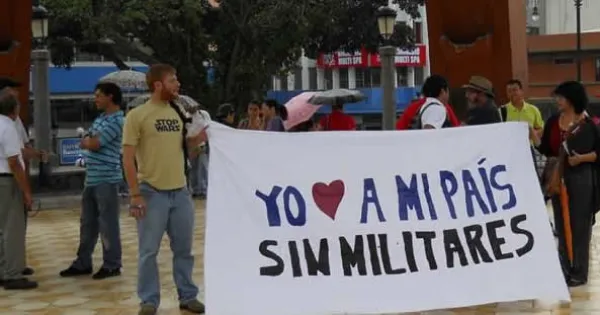
The forthcoming film, A Bold Peace: Costa Rica's Path of Demilitarization, should be given every possible means of support and promotion. After all, it documents the blatant violation of laws of physics, human nature, and economics, as understood in the United States -- and the violators seem positively gleeful about it.
In 1948 Costa Rica abolished its military, something widely deemed impossible in the United States. This film documents how that was done and what the results have been. I don't want to give away the ending but let me just say this: there has not been a hostile Muslim takeover of Costa Rica, the Costa Rican economy has not collapsed, and Costa Rican women still seem to find a certain attraction in Costa Rican men.
How is this possible? Wait, it gets stranger.

 If Jesus lived in Galilee in recent decades he would live in a world alive with Palestinian traditions clinging to a long-rooted history but struggling through the aftermath of the never-ended ethnic-cleansing operation that spiked in 1948.
Hatim Kanaaneh has written a fictionalized account, Chief Complaint: A Country Doctor's Tale of Life in Galilee, based on his experiences as a village doctor during the past half-century, a doctor who traveled to the United States for his education and returned to Palestine to practice his craft. His dialogue-heavy stories reach back to before 1948, merging folklore with myth and legend, featuring in the opening vignette a larger-than-life comedic but sensitive giant as short on wits as he is strong of muscle and heart.

“As I walked down the hall, one of the police officers employed in the school noticed I did not have my identification badge with me.”
The speaker is testifying before the President’s Task Force on 21st Century Policing. He was a high school freshman at the time. Ah, school days!
“Before I could explain why I did not have my badge,” he went on, “I was escorted to the office and suspended for an entire week. I had to leave the school premises immediately.”
It gets better.
“Walking to the bus stop, a different police officer pulled me over and demanded to know why I was not in school. As I tried to explain, I was thrown into the back of the police car. They drove back to my school to see if I was telling the truth, and I was left waiting in the car for over two hours. When they came back, they told me I was in fact suspended, but because the school did not provide me with the proper forms, my guardian and I both had to pay tickets for me being off of school property. The tickets together were $600, and I had a court date for each one.”