
Op-Ed

If there is a group of Americans to whom Iraqis struggling with the health effects of depleted uranium, cluster bombs, white phosphorous, and all the various poisons of war can relate, it might be the mostly black and largely poor residents of Gibsland, in northern Louisiana.
Here's how an op-ed in the New York Times from one resident describes their situation:
"For years, one of the largest employers in that area was the Louisiana Army Ammunition Plant, about four miles from Minden. The Environmental Protection Agency eventually listed the plant as a Superfund site because for more than 40 years 'untreated explosives-laden wastewater from industrial operations was collected in concrete sumps at each of the various load line areas,' and emptied into '16 one-acre pink water lagoons.'"
And now (from Truthout.org):

Oh, the moral force of a snub.
Several hundred cops turn their backs on New York’s mayor as he eulogizes one of their own, killed in the line of duty, and the media have another us-vs.-them story to report. Bill de Blasio’s in trouble, accused of playing politics with the lives of heroes. And, of course, the story goes no deeper than the dramatic accusation.
As the sign of a lone protester at the officer’s funeral proclaimed: “God bless the NYPD: Dump de Blasio.”
There’s nothing like a good, righteous condemnation to stop a national discussion. Criticizing police tactics means contributing to an anti-police atmosphere. End of debate.
Personally, I view the snub, by some New York police, as de Blasio’s red badge of courage more than his moral condemnation. He stood for something outside the zone of official righteousness. He met with protesters. He ended stop-and-frisk, the tactic of warrantless street searches that primarily targeted blacks and Hispanics. He told his biracial son to “take special care in any encounter he has with police officers,” in other words, refused to sugarcoat a pragmatic truth.
“The only good Talib is a dead Talib.”
These words, uttered half a decade ago by the head of intelligence for the NATO coalition force in Afghanistan, summon a far earlier American savagery. As the American empire affects to close the door on its war with Afghanistan, the words also serve as a sort of doorstop propping open our further intervention in this broken country.
The war isn’t really ending. Some 18,000 foreign troops will stay in Afghanistan, almost 11,000 of them American, under a new mission called “Resolute Support.” U.S. forces will also have “a limited combat role as part of a separate counterterrorism mission,” according to the Wall Street Journal. Incredibly, we’re not letting go. We’re just disappearing the combat mission into global background noise.
What to do about the political mess in the Middle East and the rise of the Islamic State and related political movements?
Shortly after the end of World War II, the Western powers and the whole world began to recognize that the age of explicit colonial domination was over, and dozens of colonies were let go of and took political independence.
It is now past time for the United States and other world powers to recognize that the age of neo-colonial military, political and economic domination, especially in the Islamic Middle East, is decisively coming to a close.
Attempts to maintain it by military force have been disastrous for ordinary people trying to survive in the affected countries. There are powerful cultural currents and political forces in motion in the Middle East that simply will not tolerate military and political domination. There are thousands of people prepared to die rather than accept it.
U.S. policy will find no military fix for this reality.
“We have brought torture, cluster bombs, depleted uranium, innumerable acts of random murder, misery, degradation and death to the Iraqi people and call it 'bringing freedom and democracy to the Middle East'. – Harold Pinter
British playwright Harold Pinter won the Nobel Prize for Literature in 2005. His powerful acceptance speech exposed the United States for its fascist, imperialist policies since World War II. His speech (delivered three years before he died in 2008) was an important glimpse into – and a reasonable summary of -- the innumerable documentable US imperialistic crimes that have been secretly facilitated by our multinational corporations, our national security apparatus, our military leaders, our wealthy elites and the craven politicians who are beholden to those four realities that have shaped American foreign policy over the past 60 years.
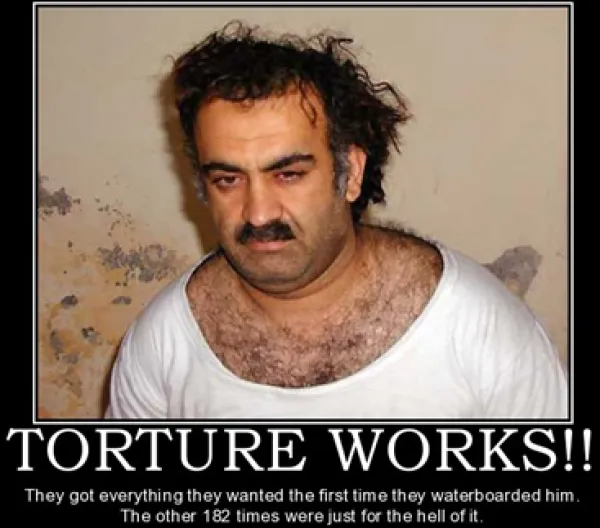
“This is not who we are. This is not how we operate,” were the words of President Barack Obama commenting on the grisly findings of a long-awaited congressional report on the use of torture by the US Central Intelligence Agency (CIA).
But what if this is exactly who we are?
The Senate Select Committee on Intelligence has been taking bows for being the guardian of American law, decency, and character. It’s not. It’s not even close. American law, decency, and character have yet to be redeemed. Worse, only a small percentage of Americans in or out of power seems to care enough to act against the pall of moral failure still spreading through the culture.
The intelligence committee has done a good, small thing in its effort to make some partial truth somewhat better known, but its report is fundamentally short on meaningful intelligence. This is a committee divided against itself that nevertheless managed to exceed expectation by a bit. But this committee is no truth commission. The committee’s report is a negotiated settlement in which the perpetrators exercised too much control over the content.
The shock resonating from the Senate Intelligence Committee’s CIA torture report isn’t due so much to the revelations themselves, grotesque as the details are, but to the fact that they’re now officially public. National spokespersons (except for Dick Cheney) can no longer deny, quite so glibly, that the United States is what it claims its enemies to be.
We’re responsible for the worst sort of abuses of our fellow human beings: A half-naked man freezes to death. A detainee is chained to the wall in a standing position for 17 days. The stories have no saving grace, not even “good intelligence.”
The Axis of Evil smiles, yawns: It’s home.
The question is, what do we do with this moment of national self-awareness? Beyond demanding the prosecution of high-level perps, how about really changing the game? I suggest reviving S. 126, a bill introduced into the U.S. Senate on Jan. 4, 1995 by Daniel Patrick Moynihan, titled: Abolition of the Central Intelligence Agency.
Senator Ron Wyden has a petition up at MoveOn.org that reads "Right now, torture is banned because of President Obama's executive order. It's time for Congress to pass a law banning torture, by all agencies, so that a future president can never revoke the ban." It goes on to explain:
"We live in a dangerous world. But when CIA operatives and contractors torture terrorist suspects, it doesn't make us safer -- and it doesn't work. The recent CIA torture report made that abundantly clear. Right now, the federal law that bans torture only applies to the U.S. military -- not our intelligence agencies. President Obama's executive order barring all agencies from using torture could be reversed, even in secret, by a future president. That's why it's critical that Congress act swiftly to pass a law barring all agencies of the U.S. government, and contractors acting on our behalf, from engaging in torture. Without legislation, the door on torture is still open. It's time for Congress to slam that door shut once and for all."
Why in the world would anybody object to this unless they supported torture? Well, let me explain.
If you hadn't previously heard the expression 'near term human extinction', you have now. And you will get used to hearing it soon unless you insulate yourself from reality with greater effectiveness than you are doing by reading this article.
The expression 'near term human extinction' is relatively new in the scientific literature but, unlike other truths that have been successfully suppressed by national elites and their corporate media, this one will keep filtering out until you start to hear the expression routinely. Why? Because this truth is simply too big to suppress permanently and the planetary environment delivers its feedback directly to us in the form of catastrophic environmental events, climatic and otherwise, whether or not these are reported by the corporate media.