
Op-Ed

Dostoievski once had a character imagine what a head would think if for some seconds it were aware of having been cut off by an executioner's guillotine, or if somehow it were aware for a full minute, or even for five minutes.
I should think such a head would think thoughts entirely dependent on the circumstances and that the type of blade that committed the murder wouldn't affect the thoughts too greatly.
I loved you, it might think, thinking of its loved ones. I did well there, if might think, thinking of its accomplishments. I'm sorry, it might think, dwelling momentarily on its deepest regrets -- as likely as not relatively trivial incidents in which the head together with its body had hurt someone's feelings.
I've died in a war, the head might think, despite opposing wars. I took the risk and enjoyed the thrill, yet the injustice remains. I didn't launch the war. I didn't make millions off it. I didn't win votes from it. I tried to tell people what it was, and here I am no better than a soccer ball about to cease existing as a consciousness.

Finally, somebody commenting on the state of Iraq thinks George W. Bush got something right. Turns out it's ISIS. In the new hour-long ISIS-produced film about how nice it is to die for ISIS -- Flames of War: Fighting Has Just Begun -- Bush is quoted: "You are with us or against us." Video shows him saying "Either you are with us or you are with the terrorists." A graphic in the upper corner of the screen reads: "Bush spoke the truth, although he's a liar."
What truth does ISIS think Bush spoke? The Manichean truth that there are two groups of people on earth with nothing in common between them and a shared dedication to annihilate each other. Of course, the notion that they have nothing in common is delusional. They have almost everything in common: their belief in violence, their monotheism, their stupidity, their desire for a U.S. war in the Middle East.
"In the face of the dark wave of the crusader force..." begins the ISIS movie.
"This crusade, this war on terrorism, is going to take a while," said Bush.
Barack Obama’s central dilemma last week, when he tried to sell a new war to the American public on the eve of the thirteenth anniversary of 9/11, was to speak convincingly about the wisdom and effectiveness of U.S. foreign policy over the last decade-plus while at the same time, alas, dropping the bad news that it didn’t work.
Thus: “Thanks to our military and counterterrorism professionals, America is safer.”
Hurray! God bless drones and “mission accomplished” and a million Iraqi dead and birth defects in Fallujah. God bless torture. God bless the CIA. But guess what?
“Still we continue to face a terrorist threat. We cannot erase every trace of evil from the world, and small groups of killers have the capacity to do great harm.”
So it’s bombs away again, boys — another trace of evil has popped up in the Middle East — and I find myself at the edge of outrage, the edge of despair, groping for language to counter my own incredulity that the God of War is on the verge of another victory and Planet Earth and human evolution lose again.

War, our leaders tell us, is needed to make the world a better place.
Well, maybe not so much for the 43 million people who’ve been driven out of their homes and remain in a precarious state as internally displaced persons (24 million), refugees (12 million), and those struggling to return to their homes.
The U.N.’s figures for the end of 2013 (found here) list Syria as the origin of 9 million such exiles. The cost of escalating the war in Syria is often treated as a financial cost or — in rare cases — as a human cost in injury and death. There is also the human cost of ruining homes, neighborhoods, villages, and cities as places in which to live.
Just ask Colombia which comes in second place following years of war — a place where peace talks are underway and desperately needed with — among other catastrophes — nearly 6 million people deprived of their homes.

We live in a time fraught with bad news. From the toll of violence and poverty to the escalating march of climate change, every week brings temptations to despair. Hope may actually be more beleaguered in the wake of a president who won the office in part by branding himself with it. Many have concluded that political participation has become a futile game.
For myself, I deal with potential despair by finding ways to act. And remembering that the doors to social change are never irrevocably closed, even in unimaginably difficult situations. Think of Nelson Mandela and his compatriots being told they would rot and die on Robben Island. Denied newspapers as a way of isolating them, they’d see a guard discard a newspaper he’d used to wrap his sandwich, and one of the prisoners would retrieve it, smuggle it under their shirt, and in a tiny coded script on toilet paper (the only paper they had), would circulate a story or headline that would give their compatriots courage.

I know you mean well. I know you think you've found a bargain that nobody else noticed hidden in a back corner of the used car lot. Let me warn you: it's a clunker. Here, I'll list the defects. You can have your own mechanic check them out:
“So you want to disarm cops LOL yeah that’s an intelligent thing to do the gang bangers would love that surely they will unilaterally disarm too.”
I’m used to semi-anonymous sarcasm by now, like this Huffington Post comment beneath a recent column I wrote on the militarization of the police and the possibility of disarmament, and I have no interest in “fighting it out” with the guy. But there it is, perfectly preserved: an impulse homage to Big Fear, wrapped in unexamined certainty. This is fast-draw morality, made in Hollywood.
I take this moment to highlight it because it’s so typical and, for that reason, the first line of defense of the status quo of violence: this instant acceptance of the idea that our enemies are continually stalking the perimeter of our lives, waiting to invade, to commandeer our way of life the moment we lower our weapons.
Remarks at North Carolina Peace Action Event in Raleigh, N.C., August 23, 2014.
Thank you for inviting me, and thank you to North Carolina Peace Action, and to John Heuer whom I consider a tireless selfless and inspired peacemaker himself. Can we thank John?
It's an honor for me to have a role in honoring the 2014 Student Peacemaker, iMatter Youth North Carolina. I've followed what iMatter has been doing around the country for years, I've sat in on a court case they brought in Washington, D.C., I've shared a stage with them at a public event, I've organized an online petition with them at RootsAction.org, I've written about them and watched them inspire writers like Jeremy Brecher whom I recommend reading. Here is an organization acting in the interests of all future generations of all species and being led -- and led well -- by human kids. Can we give them some applause?
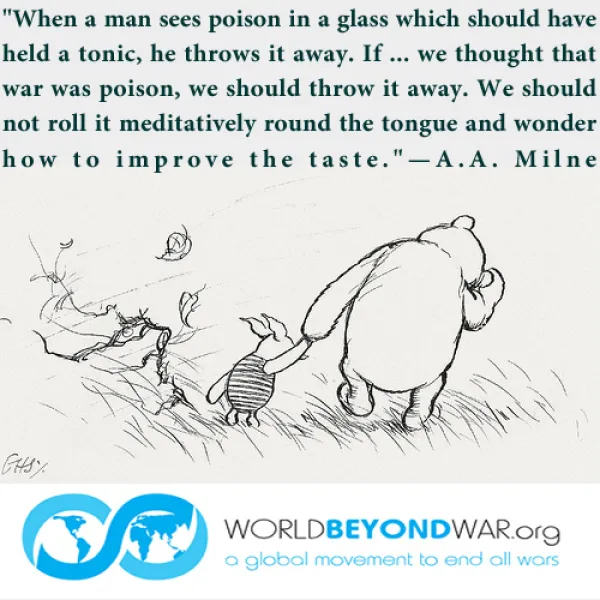
In the 1920s and 1930s, anybody who was anybody tried to figure out how to rid the world of war. Collectively, I'd say they got three-quarters of the way to an answer. But from 1945 to 2014, they've been ignored when possible (which is most of the time), laughed at when necessary, and on the very rare occasions that require it: attacked.
What a flock of idiots the leading thinkers of a generation all must have been. World War II happened. Therefore, war is eternal. Everyone knows that.
But slavery abolitionists pushed on despite slavery happening another year, and another year. Women sought the right to vote in the next election cycle following each one they were barred from. Undoubtedly war is trickier to get rid off, because governments claim that all the other governments (and any other war makers) must go first or do it simultaneously. The possibility of someone else launching a war, combined with the false notion that war is the best way to defend against war, creates a seemingly permanent maze from which the world cannot emerge.