
Global
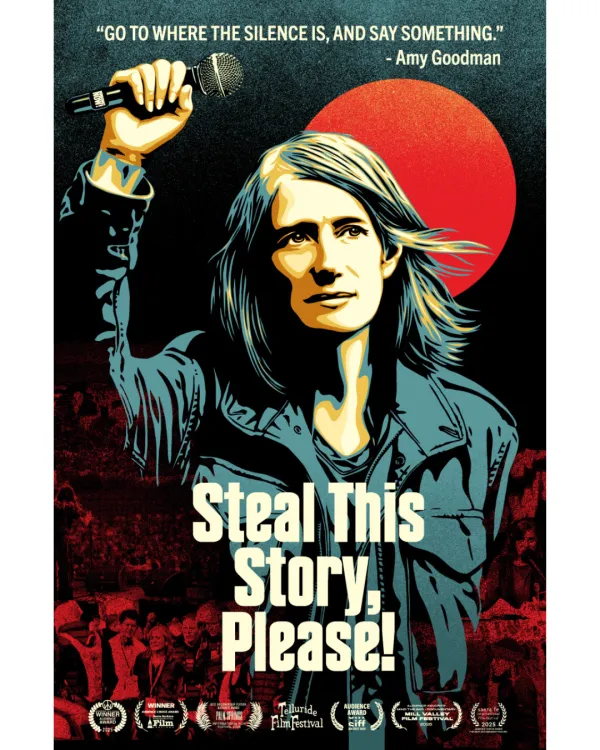
This article first appeared on Reeltime with RIchard Ades
The past year has been a scary one for Americans who believe in freedom of the press. Faced with an autocratic president who works to stifle his critics with a combination of favors, threats, lawsuits and every other means at his disposal, one media company after another has been willing to compromise its integrity.
That’s what makes Steal This Story, Please! such an refreshing experience. Co-directed by Tia Lessin and Carl Deal (2008’s Trouble the Water), the documentary introduces us to Amy Goodman, a radio/TV journalist who absolutely refuses to compromise her own integrity.
Indeed, integrity seems to be baked into her character along with courage, stubbornness and—surprisingly for someone who takes her work so seriously—a sense of humor. All of these qualities come out in the doc, as they do in the 30-year-old news program Goodman founded and co-hosts, Democracy Now!

VETERANS FOR PEACE STATEMENT OF SUPPORT

Yes, I’m still trying to write a book. Meanwhile, horrific wars rage and the outrage I feel quietly morphs into helplessness and then, after a while, shame. I believe, in some deep place inside me, that we can move beyond this. I know we can.
I also believe I have a role to play, as a writer, to help push our collective awareness beyond a public shrug over the cost and consequences of militarism: our trillion-dollar-plus military budget and ho-hum acceptance of the “collateral damage” that budget inevitably winds up creating . . . over there somewhere. This is simply assumed to be the nature of power. You know, dominance. It’s how we stay safe.
What I want to cry out is that this is fake power. It’s a trap. It keeps us in hell. Connection and creative conflict resolution are a different form of power. When we listen to and empathize with our “enemy,” we can start seeing beyond the moment and working to create a world that works for everyone. We can only evolve together.

Many remember Ted Turner as the owner of the Atlanta Braves or conceptualizer of 24 hour cable TV media like CNN. But his relationship with animals as a hunting entrepreneur, is less reported and revolting to some animal lovers.
Turner owned ranches in Colorado, Kansas, Montana, Nebraska, New Mexico, and South Dakota where hunters paid thousands to kill bison, deer, African antelopes and turkeys he provided.
Turner co-founded Ted's Montana Grill in 2002,a restaurant chain founded on selling bison (buffalo) meat that had roughly 37 to 40 outlets in a dozen states.
Ted's Montana Grill was a way to unload hunted bison from Turner's 50,000 animals bison herd---the world's largest private holding at the time according to published reports. It was an inspiration to other ranchers to grow bison of their own who could become burgers, steaks, meatloaf and short ribs at the Grill.
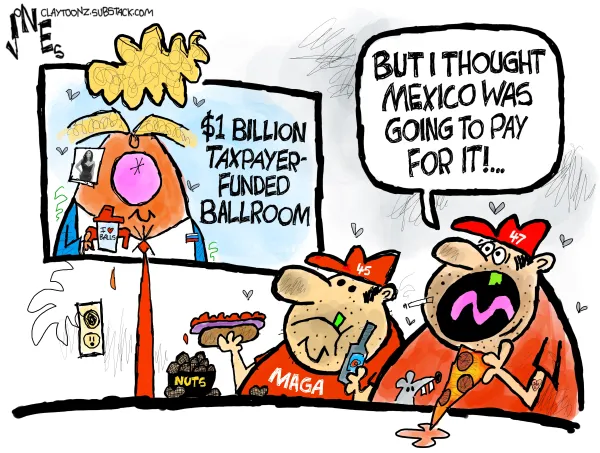
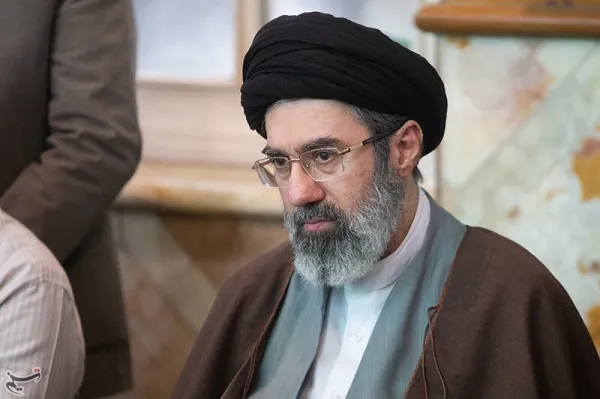
President Trump has repeatedly suggested that any new leaders of Iran who don't meet his approval won't last long. Does this mean that they will be assassinated like their recent leaders?
What future leaders of Iran would be more acceptable to the US? One possible candidate is Narges Mohammadi, a longtime human rights activist who won the Nobel Peace Prize in 2023. She has been in and out of Iranian prisons since 1998 for criticizing the Iranian government, belonging to banned organizations, supporting human rights and various other charges.
Perhaps if President Trump could secure a deal for her release, she could emerge as a leader for reform and change within Iran. Trump might be willing to help her if she turns over her Nobel Peace Prize to him. But he already has one anyway from someone else so that might not be enough of an incentive for him.

Wednesday, May 6, 2026, 7:00 PM
Zoom
An awesome and creative action can undermine fear and lies, throw the opposition off its game, protect vulnerable people from harm, make confronting bigots fun, AND tell a great story, all at the same time. The best part? Just about anybody can pull one off with a good idea, planning, and a few friends. Join us for this 75-minute training on how to build and amplify a stellar action or just be a creative participant.
Register here or follow States at the Core to find a training that fits your schedule.

Before he was J.D. Vance, he was James David Hamel. Before that, James Donald Bowman. The name he carries today he chose himself in 2013 — months before graduating Yale, crafting an identity as carefully as any political brand.
And a name, as it turns out, was not the only part of his identity that J.D. Vance was willing to shed. In 2019, the former atheist was baptized into the Catholic Church at a Dominican priory in Cincinnati named St. Gertrude’s.
By the time J.D. Vance arrived on the national stage, very little of the original remained. Peter Thiel gave Vance a job, a philosophy, and millions of dollars.
The Catholic Church gave him a name — Augustine — and a priest to baptize him. What both had in common, it turns out, was something older and powerful, a personal prelature of the Catholic church known as Opus Dei, and a very specific vision for the future of America.
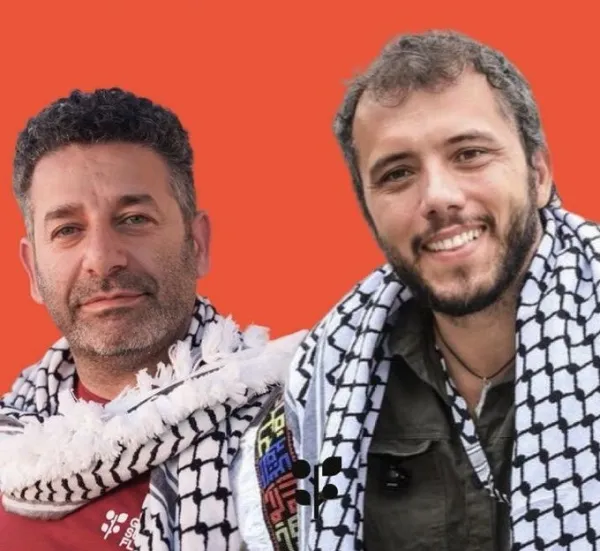
An Israeli court has extended the detention of two activists from the Global Sumud Flotilla, who were brought to Israel for interrogation and torture. Spanish national Saif Abu Keshek and Brazilian national Thiago Ávila were arrested after Israeli forces intercepted their boat in international waters on April 29, 2026. The two activists are being held on baseless charges because they were among the flotilla’s lead organizers.
If the Israeli government can accuse anyone of “contact with a foreign agent” or “terror organization,” then by the same logic, any Israeli citizen who joined the IDF—an army accused internationally of committing genocide—should be subject to arrest abroad. Israel is seeking reciprocal arrests; the rest of the world should respond in kind, especially Brazil, Spain, and other countries whose nationals have taken part in the Israeli military campaign in Palestine and Lebanon.

Over the past decade, the United States has entered a sustained phase of military expansion accompanied by widening geopolitical commitments and renewed great-power competition. While this trajectory is routinely justified in the language of national security, it exposes a deeper structural reality in American public finance: the systematic privileging of hard power and external commitments over long-term domestic investment. Nowhere is this imbalance more visible than in the divergence between rapidly expanding Pentagon expenditures, persistent foreign military aid—particularly to Israel—and the comparatively constrained growth of federal research funding through institutions such as the National Institutes of Health (NIH).