Advertisement

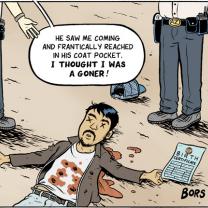
(Stony Ridge, OH) For decades a quiet neighborhood in the suburbs of Toledo, Ohio has been home to working class Americans and the place where their children were raised. There is even a local park and playground right around the corner complete with Little League field. Its idyllic serenity has not been spared from the pains of the current economic and housing crisis. On the morning of May 3rd, one working-class anarchist and laid-off auto-worker facing eviction resulting from just one more of the nearly 1.5 million foreclosures in the U.S., decided that now was the time to stand his ground.

I was unaware that SOS did not require the precincts to have paper ballots on hand for the primary. I do not disagree with that decision, as it seems to me that it would be a pretty high cost for just a few people like me who dont trust the machines and wish to vote on paper.

When my wife and I went to the polls this morning, she asked for paper ballot and was asked the reason she was asking for it. She refused to answer and left the polling place, with the intention of returning later. She (we)did not feel that question was appropriate. I asked for paper, and gave the reason that I did not trust the machines.

I was then given a provisional ballot envelope. I informed them I did not want to vote provisionally, I wanted my vote to be counted tonight, not next week. The informed me that all paper ballots needed to go into the envelope for privacy, and that all paper ballots would be treated as provisional. I was decidedly unhappy at this point, still not realizing that SOS did not order paper ballots to be available. At this point, I decided to vote on the machine.

Santa Rosa, CA (2. April 2010) With the media coverage on the horrific Gulf Coast oil spill largely centering on the volume of the spill and efforts to stem the outflow, Post Carbon Institute offers 12 additional important angles, each tackled by one of the Institute’s 29 acclaimed Fellows. For further perspectives, information and insight contact the Institute.

1. The Ripple Effect

RICHARD HEINBERG (Senior Fellow – Energy & Climate) – We’ve only just begun to see the true cost of the Gulf Coast oil spill. As we saw with Hurricane Katrina, the ripple effect of disruptions in oil supply can lead to profound and surprising outcomes. When you add the unimaginably large costs associated with the discovery and delivery of deep water oil to the even more prohibitive costs of cleanup and damage control and remove the oil industry subsidies, suddenly ‘alternative’ energy supplies seem far more mainstream, affordable and realistic.

Back when "tin soldiers and Nixon" were "cutting us down" in 1970, a group of Ohio State University students and campus activists started an underground newspaper in Columbus. Driven mostly by the murder of four students at Kent State - Allison Krause, Jeff Miller, Sandy Scheuer, and Bill Schroeder - shot during a demonstration that was opposing President Nixon's illegal attack on Cambodia and the Vietnam War, the Columbus Free Press was born.

Not surprisingly, the Free Press was the first western newspaper to expose Cambodia's killing fields thanks to international law professor John Quigley's reporting from Southeast Asia.

In the first issue of the Free Press, the October 11, 1970 issue, a Free Press opinion attacked a special grand jury's decision not to indict Ohio National Guardsmen for the Kent State killings. The Free Press wrote at the time: "The jury conveniently disregarded the FBI report which stated that the guardsmen were not 'surrounded,' that they had tear gas, contrary to claims of guardsmen following the shooting."

Legend says curses come in threes. Let's pray that doesn't happen with the unholy trinity of the Corporate Climate Bill.

It demands drilling for oil, digging for coal and big money for new nukes. How such a devil's brew could help save the Earth conjures a corporate cynicism beyond the scope of the human mind and soul.

It all now bears a special curse. It was meant for Earth Day. Then it slipped to the April 26 Chernobyl anniversary. But co-sponsor Lindsay Graham (R-SC) pitched a fit over immigration and pulled his support.

As did Earth herself. Just prior, more than two dozen hill country miners were killed in a veritable Three Mile Island of black carbon. This entirely avoidable accident was built on years of sloppy denial by King Coal and the tacit assent of pliant regulators. With mountains of offal being pitched into rivers and streams, and underground hell holes filled with gas and soot, coal has been slaughtering people and eco-systems here for more than a century. Now, as at TMI, the death has become visible.

BANGKOK, Thailand -- Two Thai faces appear behind the sharpened bamboo poles and hundreds of car tires which form lengthy menacing barricades, now stinking of urine, rotten food and other debris, along Bangkok's busy downtown streets.

The face of British-born and Oxford-educated Prime Minister Abhisit Vejjajiva, hated by the thousands of Red Shirts behind the barricades, is plastered all over their occupied zone.

His eyes are cut out, or reddened along with his mouth to make him appear ghoulish, on handbill-sized posters which place him above photographs of three corpses.

A bullet hole punctures the center of one man's forehead. Another dead man is wrapped in Thailand's red-white-and-blue national flag on a gurney. A third man lays in the street with a chunk of his bloodied head missing.

They were among the 25 people killed, and 900 injured, when Abhisit and the military failed to crush the Red Shirts on April 10.

The other face behind the nine-foot (three-meter) tall barricades is of the authoritarian Thaksin Shinawatra, who won three elections before being toppled in a 2006 military coup.

The panic has set in at the Big D in the state capitol. The staid daily monopoly, also known as the Columbus Dispatch, published an op-ed by senior editor Joe Hallett confirming what the Free Press previously reported – Tea Party activists will take over the Buckeye State’s Republican Party.

By Hallett’s estimate, the 66-member Republican state central committee has 54 Tea Party activists running in Tuesday’s primary. How many are expected to win? A high-level Republican official told the Free Press that he thinks 50 of the 66 seats may go to the Tea Party. However, the official cautioned that he’s not as sure as the Free Press or the Dispatch that the Tea Party activists are “far right.” He claims most are “fiscal conservatives.”

Hallett doesn’t see it that way. He writes that if the Tea Party takes over the Ohio Republican Party central committee, “…the Ohio GOP will die.” Where does Hallett see the Tea Party heading? That direction, indeed, is "right, far right."

War makers, torturers, warrantless spyers, and all sorts of other categories of criminals are still off the hook. But there is a bit of "looking backward" going on. Two out of the three people whom we at StopTheChamber.com have asked for criminal investigations of are now under investigation. We're wondering about the third, the big one, the one that ties the other two and so much more together.

On April 12th, we asked for criminal charges against Massey Energy's Don Blankenship for the homicide of mine workers. We set up Facebook and Twitter campaigns in support. On the 15th, we sent a formal request to the attorney general for a special prosecutor. On the 26th we posted a video of Robert F. Kennedy, Jr., calling for the prosecution of Blankenship. Kennedy said that “Massey Energy is a criminal enterprise” that "cannot do business without breaking the law." He said that Don Blankenship should be "in jail."

Massey is now facing a criminal investigation for the mine blasts, and possible bribery.

On February 1, 1960, four black students took seats at a lunch counter at the Greensboro, North Carolina, Woolworth’s. The white waitresses ignored them. They remained in their seats. Supervisors told them to leave. Woolworth’s in North Carolina didn’t serve colored people. The students refused to move and demanded service.

In the early Spring of 1960, I went with two other students from Madison, Wisconsin, to Montgomery, Alabama, to try to build a civil rights support network. We met with Reverend Ralph Abernathy in Montgomery and established links with his church; then to Birmingham and Reverend Fred Shuttlesworth.

As we descended the steps of his church an Alabama state policeman met us and told us to drive to the Mississippi border without stopping. He followed us, red light on top of his car blinking. As we entered Mississippi, a highway patrol car met us. That cop delivered similar orders and followed us to the Tennessee border. The white power felt uneasy.

Pages

Subscribe to Freepress.org RSS