
Human Rights

"What is the Palestinian strategy?" is a question that I have been asked all too often, including on 15 May, the day that millions of Palestinians around the world commemorated the 67th anniversary of the Nakba, the ethnic cleansing of the Palestinians by Zionist militias in 1947-48.
The question itself doesn’t require much elaboration, as in, "What is the Palestinian strategy to combat Israeli military occupation, siege violence, apartheid and racial discrimination?" The painful reality is well known to many, although few take on the moral responsibility to confront it.
And the posing of the question is telling in itself. It wouldn’t be asked if there was a strategy in place, being implemented, and regularly revisited and modified. The question is a testament to all the failures of past strategies, and the political disintegration of any credible Palestinian leadership, currently represented by Mahmoud Abbas and his circle of wealthy businessmen and "politicians".

If we could see a Mother’s Day
All around the world,
Where mothers lived a day of joy,
Where mothers felt their worth,
Then what exactly would we see
So moms could realize
That their lives are important and
Their own perspectives wise?
The women in Sudan would not
Be flogged for wearing pants.
Their spirits wouldn’t be constrained;
They’d run, skip, sing, and dance.
In Arabia we’d celebrate
No groping of the girls;
They’d drive their cars with elbows bare,
Show ankles under skirts.
As golden rays of morning light
Touched arms tan from the sun,
Brown locks of hair blown by the breeze
From scarves could come undone.
And no false blame on women for
Attracting hands of men,
As if the hands were victims of
The evil feminine.
Instead of yoking women, telling
Them they have to hide,
The men without firm self-control
Would wear handcuffs outside.
There just might be a big boost in government honesty soon, as both houses of Congress have now passed with two-thirds votes and sent to the states for ratification a potential 28th amendment to the U.S. Constitution bearing the unofficial title "The Truth in Advertising Amendment." This is the text as passed by Congress:
Amendment 28
Preamble: The first through tenth articles of amendment to the Constitution of the United States are hereby repealed.
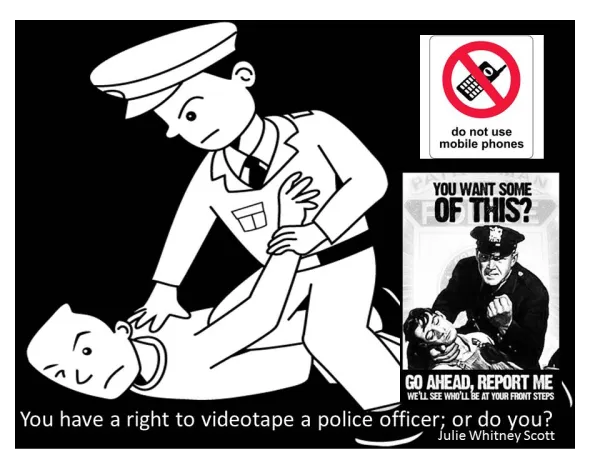
Once upon a time if you were stopped by the police, and for whatever reason, found yourself being the victim of police brutality, even with witnesses, you would lose in a court of law based on the “word” of the police officer(s) involved.
If the police officer, after he shot a “suspect,” called in to the station to report “Man down, man shot, he took my Taser,” it would be assumed by the dispatcher that the officer needed back-up and shot the “suspect,” eight times, in self-defense. The news and media reports would tell the public that the “suspect” died as a result of the police officer using “necessary force” to protect himself. Although many of us who heard the police explanation and the news reports didn’t believe we were getting the truth, there wasn’t much we could do or say about it and eventually, like all of the other times, the story would fade away.

Are innocent citizens pulled over, beaten and arrested by Columbus Police?
Meet Dale Phillips. He claims he was roughed up, thrown to the ground, maced directly into his eyeballs and violently assaulted resulting in a ripped bicep tendon. His so-called “crime” – trying to back his car up to allow a police cruiser to proceed through an intersection. The charge -- ironically, “obstructing official business.”

Lightning flashed across Kentucky skies a few nights ago. "I love storms," said my roommate, Gypsi, her eyes bright with excitement. Thunder boomed over the Kentucky hills and Atwood Hall, here in Lexington, KY's federal prison. I fell asleep thinking of the gentle, haunting song our gospel choir sings: "It's over now, It's over now. I think that I can make it. The storm is over now."
I awoke the next morning feeling confused and bewildered. Why had the guards counted us so many times? "That was lightning," Gypsi said, giggling. The guards shine flashlight in our rooms three times a night, to count us, and I generally wake up each time; that night the storm was also a culprit.
As the day continued we saw large pools of water had collected at each entrance to Atwood Hall. Prisoners from drought-ridden areas wish they could collect the rainwater and send it home. Fanciful notions, but of the kind, at least, that can help us remember priorities. I suppose it's wise, though, to focus on what can be fixed. The elevator here, for instance.
(updated 12-05-2022)
“The basic principle of parole is that while people must be punished for their wrongdoing, most are capable of growing, changing and rejoining society before the end of their sentence…. The difficult job of determining when someone is ready is entrusted to parole boards, which should weigh, among other things, a person’s behavior behind bars and the likelihood that he or she will not commit another offense if released.” ~ New York Times editorial, February 16, 2014.

BANGKOK, Thailand -- Former Prime Minister Yingluck Shinawatra, whose
government was toppled by a military coup in May, faces a possible 10
years in prison after the Supreme Court on Thursday (March 19) ordered
her trial for alleged negligence when she administered rice subsidies.
"I am innocent," Ms. Yingluck said on her Facebook page, hours after
the court's announcement.
The crop subsidies "enhanced the living standards of the rice
farmers," she said.
"The Supreme Court's Criminal Division for Holders of Political
Positions has authority to consider the case," the court ruled on
Thursday (March 19).
The Attorney General's office had charged her with "dereliction of
duty" for not correcting alleged problems within her government
subsidy program.
Ms. Yingluck's trial, scheduled to start on May 19, is expected to
increase divisions in this troubled and repressed Southeast Asian
country.
She remains popular despite the coup-installed junta's use of martial
law, military courts for civilian dissidents, "attitude adjustment"

BANGKOK, Thailand -- The angry, frustrated, talkative general who
seized Thailand in a military coup last May, said on Monday (March 23)
if he had "complete power" he would have "a firing squad" execute
people, but now he suffers insomnia because Thais are demanding
democracy.
In 2003, Thailand stopped roping convicts to a cross with arms
outstretched, to be shot in the back by a lone executioner, and
instead began lethal injections.
"I can't even stop people from opposing me at this moment," Gen.
Prayuth Chan-ocha said in a speech at a Federation of Thai Industries
convention here in Bangkok.
"If I genuinely had complete power, I would have imprisoned [critics]
or handed them to a firing squad. It would be over, I wouldn't have to
wake up at night like this.
"Today there are some people who love me, but there are also many
people who hate me," he said from a podium in front of a gigantic
screen which vividly projected Gen. Prayuth speaking,
larger-than-life.
The general, who also played a role in a bloodless 2006 coup, has

During a press conference on Monday, March 16, Siddique Hasan announced that a hunger strike was underway at the Ohio State Penitentiary (OSP). Hasan had called in to the press conference from a phone within OSP, also known as the “Supermax” prison, in Youngstown, Ohio. He told the reporters he had missed his last three meals.
Hasan is one of the four “Lucasville Five” inmates who are on death row at OSP as a result of their presence at the Lucasville prison uprising in 1993. His fellow Lucasville Five members, Bomani Shakur (Keith Lamar) and Jason Robb are also participating in the hunger strike.
Hasan outlined the reason for the current hunger strike. The root of the problem began when a new inmate at OSP stabbed a guard in the neck and punched one in the face. Instead of dealing with that one individual, OSP prison officials applied collective punishment to everyone in OSP under Level Five security.