
Human Rights
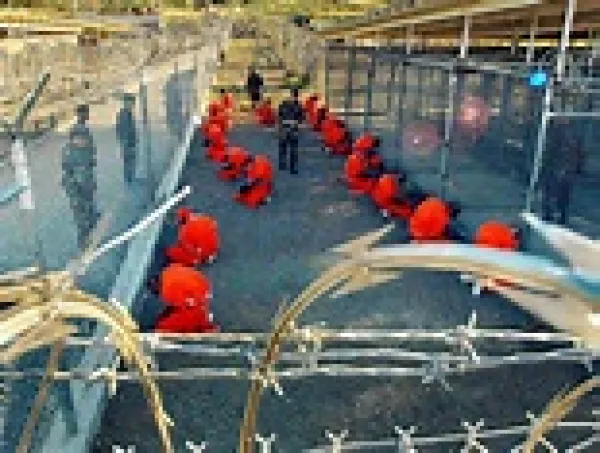
 hat do you say about the blameless man who was held at the Guantanamo concentration camp for 13 years, without trial, without charges against him, without credible evidence that he had done anything remotely deserving of 13 years of torture and isolation, with no hope of anything remotely like justice?

Of all the excuses ladled out for the Obama administration's shredding of the Fourth Amendment while assaulting press freedom and prosecuting “national security” whistleblowers, none is more pernicious than the claim that technology is responsible.
At first glance, the explanation might seem to make sense. After all, the capacities of digital tech have become truly awesome. It’s easy to finger “technology” as the driver of government policies, as if the president at the wheel has little choice but to follow the technological routes that have opened up for Big Brother.
Now comes New York Times reporter Charlie Savage, telling listeners and viewers of a Democracy Now interview that the surveillance state is largely a matter of technology: “It’s just the way it is in the 21st century.”

There is a possibility that you have heard of the famed British author, J K Rowling, writer of the popular fantasy series ‘Harry Potter’. While I knew of her books –through my teenage kids – I knew little about the author herself, until recently.
Under an oblique title, “Israel needs cultural bridges, not boycotts”, Rowling, along with a few celebrity writers, argued against growing calls for an academic boycott of Israel.
Using generalized, ambiguous terminology that offered little by way of compelling Israel to end its ongoing Occupation in Jerusalem and the West Bank, genocide and siege in Gaza and protracted institutional discrimination against Arabs and other minorities in Israel, she argued for ‘cultural engagement’, instead. Such engagement, her letter reads, “builds bridges, nurtures freedom and positive movement for change. We wholly endorse encouraging such a powerful tool for change, rather than boycotting its use.”
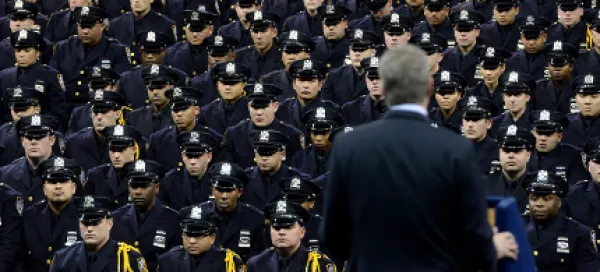
Since when did we decide that police officers should be above the law?
 wo of the biggest police unions in the country are now on record in opposition to free speech. They are on record against constitutionally protected free speech that opposes the epidemic of police violence across America (more than 900 killed by police so far in 2015).
So South Carolina has a special crime category called “disturbing schools,” which seems to be creating just that: disturbing schools. Very disturbing schools.
Not that I need to single out South Carolina. In my brief stint teaching writing as an outside consultant in several Chicago high schools, some 20 years ago, I was smacked broadside with the observation that the city’s educational system exhibited the behavior of an occupying army, at least in its low-income neighborhoods. Education was something imposed from above and force-fed to the students like bad-tasting medicine. It didn’t honor the students’ own culture.
What the kids needed was a generosity of understanding that the education system had no interest in giving them, preferring to help them along on their journey to adulthood with zero tolerance and metal detectors.
What has happened to our national intelligence, not to mention our national values? In the era of cellphone accountability, our lack thereof has a new poster boy: Officer Slam. Throw the insolent kid across the floor, break her arm if necessary, slap her in cuffs.
This is how we teach respect. This is how we teach math.

Serving legal documents on high visibility persons who have been involved in international criminal acts is very difficult. However, the temptation of large honoraria for speeches in the United States tripped up a former Israeli Prime Minister who has been accused of war crimes for his involvement in the murders of ten passengers (nine were killed immediately and a seriously wounded passenger died after being in a coma for several years) on the Mavi Marmara in the 2010 Gaza Freedom Flotilla.
In a telephone press conference on October 21, the international legal team that filed the lawsuit against former Israeli Prime Minister and Minister of Defense Ehud Barak described how “legal process service” or official notification of a legal claim filed against him was done. The legal team knew Barak would be in Southern California giving three talks as a part of the Distinguished Speaker Series of Southern California and hired a commercial “certified process server” to deliver the court documents to Barak.
I thought Deepa Iyer's new book, We Too Sing America: South Asian, Arab, Muslim, and Sikh Immigrants Shape Our Multiracial Future, would be about positive and jarring cultural contributions from immigrants, how their literature, music, myths, cooking, clothing, and cultural practices are merging with and influencing wider U.S. culture. I think that would be a good book. Maybe someone's written it.
This, too, is a good book, and I recommend it. But it is mostly about the all-too-familiar story of post-911 prejudice, racism, violence, and police profiling and abuse, with a particular focus on South Asians. As an opponent of murder in any form, my first response to this topic is usually: Take the guns away! Hatred doesn't kill people -- hatred in people with guns kills people! But of course I'd love to take the hatred away as well and get the gun deaths down to accidents, suicides, and non-hate crimes.
I admit some uncertainty as to how we can identify a gun murder as free of hate. Here's how Iyer describes hate crimes:
My first stop, after living for 22 years in a refugee camp in Gaza, was the city of Seattle, a pleasant, green city, where people drink too much coffee to cope with the long, cold, grey winters. There, for the first time, I stood before an audience outside Palestine, to speak about Palestine.
Here, I learned, too, of the limits imposed on the Palestinian right to speak, of what I could or should not say. Platforms for an impartial Palestinian discourse were extremely narrow to begin with, and when any was available, Palestinians hardly took center stage.
It was touching, nonetheless. Ordinary Americans, mostly from leftist and socialist groups defended Palestinian rights, held vigils following every Israeli massacre and handed out pamphlets to interested or apathetic pedestrians.

BANGKOK, Thailand -- A two-year-old baby's head containing only 60
percent of her brain is now being cooled by liquid nitrogen in
Arizona, the youngest person to undergo cryonic preservation for
possible revival, thanks to her parents here in Bangkok, the U.S.
Embassy, and Alcor Life Extension Foundation.
Matheryn Naovaratpong's case redefines the controversial phrase
"right-to-life" and takes it to a completely different level -- beyond
the grave -- while her parents try to extend her existence even though
most people regard the baby as deceased.
She also adds to the debate about euthanasia, and the way some people
can now control their life and death during an illness.
Spiritual belief, and its relationship to medical care, are also
involved in this baby's unusual fate.
Matheryn's Thai Buddhist parents paid Alcor $120,000, hoping their
baby's preserved brain will one day be heated up, cured of cancer, and
have its missing 40 percent regrown.
Matheryn's parents also hope she will be able to produce a new body,

When my book ‘Searching Jenin’ was published soon after the Israeli massacre in the Jenin refugee camp in 2002, I was quizzed repeatedly by the media and many readers for conferring the word ‘massacre’ on what Israel has depicted as a legitimate battle against camp-based ‘terrorists’.
The interrogative questions were aimed at relocating the narrative from a discussion regarding possible war crimes into a technical dispute over the application of language. For them, the evidence of Israel’s violations of human rights mattered little.
This kind of reductionism has often served as the prelude to any discussion concerning the so-called Arab-Israeli conflict: events are depicted and defined using polarizing terminology that pay little heed to facts and contexts, and focus primarily on perceptions and interpretations.