
The Free Press is bringing back a Reviews section after some absence. We hope to review plenty of events around town. Check back frequently and if what\'s going on is any good.
Arts & Culture
Marshalling Justice: The Early Civil Rights Letters of
Thurgood Marshall - By Michael G. Long
When Thurgood Marshal, the first black justice of the United States Supreme Court, resigned from the Court for reasons of ill health in 1991, he had served for twenty-four years. It took his death two years later for people to remember what a legacy he left this country: general counsel to the National Association for the Advancement of Colored People (NAACP) from 1938 through 1961; first black judge on the United States Court of Appeals for the Second Circuit; first black solicitor general of the United States. While with the NAACP he argued thirty-two cases before the Supreme Court, winning twenty-nine of them. During his four-year tenure on the Court of Appeals, he issued one hundred twelve rulings, none of which were reversed on certiorari by the Supreme Court. His record as solicitor general was equally impressive; he won fourteen of the nineteen cases he argued on behalf of the United States.
When Thurgood Marshal, the first black justice of the United States Supreme Court, resigned from the Court for reasons of ill health in 1991, he had served for twenty-four years. It took his death two years later for people to remember what a legacy he left this country: general counsel to the National Association for the Advancement of Colored People (NAACP) from 1938 through 1961; first black judge on the United States Court of Appeals for the Second Circuit; first black solicitor general of the United States. While with the NAACP he argued thirty-two cases before the Supreme Court, winning twenty-nine of them. During his four-year tenure on the Court of Appeals, he issued one hundred twelve rulings, none of which were reversed on certiorari by the Supreme Court. His record as solicitor general was equally impressive; he won fourteen of the nineteen cases he argued on behalf of the United States.
Guest of Honor: Booker T. Washington, Theodore Roosevelt, and the White House Dinner That Shocked a Nation
Deborah Davis
Atria Books
No doubt the vast majority of Americans did not realize that October 16 was the one hundred and eleventh anniversary of the day that Booker T. Washington, a former slave, dined at the White House at the invitation of President Theodore Roosevelt. When I relayed this information to my students, they did not get the significance of the invitation or the dinner. After all, I had taught them that black people built the White House, and it is currently occupied by a black family. What was the big deal about a dinner?
Deborah Davis
Atria Books
No doubt the vast majority of Americans did not realize that October 16 was the one hundred and eleventh anniversary of the day that Booker T. Washington, a former slave, dined at the White House at the invitation of President Theodore Roosevelt. When I relayed this information to my students, they did not get the significance of the invitation or the dinner. After all, I had taught them that black people built the White House, and it is currently occupied by a black family. What was the big deal about a dinner?
Elizabeth and Hazel: Two Women of Little Rock
By David Margolis
Yale University Press
It is one of the most searing pictures of the modern civil rights movement, and one with which I have always been fascinated: a lone black teenaged girl with her notebook hugged tightly to her chest, her face devoid of expression and her eyes obscured by sunglasses, is walking down the street. Behind her is a crowd of angry whites, one of whom’s face is contorted with rage as she yelled “Go home nigger!”
I always assumed the white girl was an adult whose face summed up the way many whites in Little Rock, Arkansas felt on that fateful day about integration in general and black people in particular. Imagine my surprise when I learned she was just fifteen years old and a student at Central High School, which Elizabeth and eight other black children were attempting to integrate that day. The white girl was Hazel Bryan, the black teenager was Elizabeth Eckford,, and David Margolis does a superb job of tracing their lives from the point of the photograph to the present.
By David Margolis
Yale University Press
It is one of the most searing pictures of the modern civil rights movement, and one with which I have always been fascinated: a lone black teenaged girl with her notebook hugged tightly to her chest, her face devoid of expression and her eyes obscured by sunglasses, is walking down the street. Behind her is a crowd of angry whites, one of whom’s face is contorted with rage as she yelled “Go home nigger!”
I always assumed the white girl was an adult whose face summed up the way many whites in Little Rock, Arkansas felt on that fateful day about integration in general and black people in particular. Imagine my surprise when I learned she was just fifteen years old and a student at Central High School, which Elizabeth and eight other black children were attempting to integrate that day. The white girl was Hazel Bryan, the black teenager was Elizabeth Eckford,, and David Margolis does a superb job of tracing their lives from the point of the photograph to the present.
Mrs. Kennedy and Me
Clint Hill with Lisa McCubbin
Gallery Books
Few people remember that when JFK was running for president, he and his top advisors thought it best to keep Jacqueline Kennedy in the background. She was too exotic, too enamored of French culture and expensive clothing, and shy to the point of being almost icy. Yet the few forays she made during the campaign–she was pregnant and having lost two babies was forbidden to campaign–showed they need not have been concerned. She was well received by perspective voters. The admiration of and interest in Mrs. Kennedy exploded when she delivered John F. Kennedy, Jr., the first baby born to a president-elect, just weeks after the election; by the time she stepped out of her N Street home to attend the Inaugural Gala, resplendent in a pure white creation by her official couturier Oleg Cassini, she was a star in her own right.
Clint Hill with Lisa McCubbin
Gallery Books
Few people remember that when JFK was running for president, he and his top advisors thought it best to keep Jacqueline Kennedy in the background. She was too exotic, too enamored of French culture and expensive clothing, and shy to the point of being almost icy. Yet the few forays she made during the campaign–she was pregnant and having lost two babies was forbidden to campaign–showed they need not have been concerned. She was well received by perspective voters. The admiration of and interest in Mrs. Kennedy exploded when she delivered John F. Kennedy, Jr., the first baby born to a president-elect, just weeks after the election; by the time she stepped out of her N Street home to attend the Inaugural Gala, resplendent in a pure white creation by her official couturier Oleg Cassini, she was a star in her own right.
Matt Bors was nominated for the Pulitzer Prize this year! Most of the Free Press cartoons on the website are the work of Matt Bors, originally from Ohio. The Free Press began using his biting political cartoons that addressed current social justice issues in our printed issue many years ago. Since then, Matt moved to the west coast and became syndicated with United Features (now Universal U-Click).
Earlier this year, Matt was nominated for a Pulitzer Prize in the cartoon category: "For a distinguished cartoon or portfolio of cartoons, characterized by originality, editorial effectiveness, quality of drawing and pictorial effect, published as a still drawing, animation or both." Another cartoonist got the Prize, but the committee cited Matt as a finalist:
"Matt Bors, syndicated by Universal U-Click, for his pungent work outside the traditional style of American cartooning."
Now Matt has a book coming out and is raising money through Kickstarter to fund his effort. It is his first collection of political cartoons titled "Life Begins At Incorporation." It's for a 225 page collection of his comics with humor essays.
Earlier this year, Matt was nominated for a Pulitzer Prize in the cartoon category: "For a distinguished cartoon or portfolio of cartoons, characterized by originality, editorial effectiveness, quality of drawing and pictorial effect, published as a still drawing, animation or both." Another cartoonist got the Prize, but the committee cited Matt as a finalist:
"Matt Bors, syndicated by Universal U-Click, for his pungent work outside the traditional style of American cartooning."
Now Matt has a book coming out and is raising money through Kickstarter to fund his effort. It is his first collection of political cartoons titled "Life Begins At Incorporation." It's for a 225 page collection of his comics with humor essays.
CICJ Books has just released "Grassroots, Geeks, Pros, and Pols: The Election Integrity Movement's Rise and Nonstop Battle to Win Back the People's Vote, 2000-2008" by Marta Steele.
Marta Steele has done yeoman work for the election integrity movement. She has plowed through more websites and blogs than one can even imagine. She set out with the nearly impossible task of writing the definitive historical narrative of the folly of electronic voting in the United States between 1988 and 2008. More shockingly, she accomplished that task.
Electronic voting machines are perfectly designed to steal elections. That's their principle purpose. Ireland has just gotten rid of them altogether. Germany, Japan, Canada, Switzerland all use paper ballots. Why? Because you can actually count them in public, and then count them again.
Marta Steele has done yeoman work for the election integrity movement. She has plowed through more websites and blogs than one can even imagine. She set out with the nearly impossible task of writing the definitive historical narrative of the folly of electronic voting in the United States between 1988 and 2008. More shockingly, she accomplished that task.
Electronic voting machines are perfectly designed to steal elections. That's their principle purpose. Ireland has just gotten rid of them altogether. Germany, Japan, Canada, Switzerland all use paper ballots. Why? Because you can actually count them in public, and then count them again.
Fifty years ago, amidst the post-World War II “victory culture” affluence, Michael Harrington’s book, The Other America came forth. The book was inspired by Harrington’s 1958 “on the road” trip across America, he encountered our country’s “invisible poor”: those caged by discrimination in the urban ghettos, the white poor of rural Appalachia, the migrant farm workers who lived in shanties without running water, and the remaining Southern sharecroppers, black and white.
A review of While We Still Have Time: The Perils Of Electronic Voting Machines And Democracy's Solution: Publicly Observed, Secure Hand-Counted Paper Ballots (HCPB) Elections, by Sheila Parks, Ed.D.
In While We Still Have Time: The Perils Of Electronic Voting Machines And Democracy's Solution: Publicly Observed, Secure Hand-Counted Paper Ballots (HCPB) Elections, Dr. Sheila Parks makes a very compelling (but scary) argument, backed up with lots of convincing evidence, showing that ALL electronic voting machines are susceptible to fraud and demonstrating that many have in fact been tampered with in recent elections.
This book is an absolute MUST READ for all citizens who are concerned that ALL votes are counted as cast. Dr. Parks shows that it is impossible to prove that electronic voting machines used in elections have NOT been tampered with. Her book is a chilling reminder that all ordinary citizens must continue to be actively involved in the political process if we want to avoid the demise of our democracy. The most precious right we have as citizens is the right to vote and have each vote be counted as intended.
In While We Still Have Time: The Perils Of Electronic Voting Machines And Democracy's Solution: Publicly Observed, Secure Hand-Counted Paper Ballots (HCPB) Elections, Dr. Sheila Parks makes a very compelling (but scary) argument, backed up with lots of convincing evidence, showing that ALL electronic voting machines are susceptible to fraud and demonstrating that many have in fact been tampered with in recent elections.
This book is an absolute MUST READ for all citizens who are concerned that ALL votes are counted as cast. Dr. Parks shows that it is impossible to prove that electronic voting machines used in elections have NOT been tampered with. Her book is a chilling reminder that all ordinary citizens must continue to be actively involved in the political process if we want to avoid the demise of our democracy. The most precious right we have as citizens is the right to vote and have each vote be counted as intended.
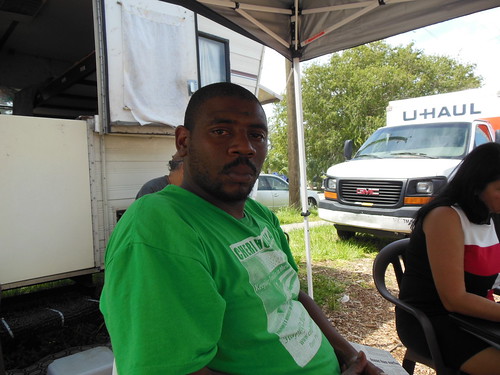 Shamako Noble is Executive Director of Hip Hop Congress and currently personal assistant to Green Party VP candidate Cheri Honkala. He didn’t sleep in a tent or rely on Romneyville’s porta johns or its converted old school bus kitchen. But he spend hours there each day to help with events that countered, in a small but more than just symbolic way, the agenda of the Republican National Convention.
And I was glad to see him and Green Party VP candidate Cheri Honkala during counter DNC events in Charlotte. Along with presidential candidate Jill Stein, they held a press conference at Marshal Park with about 40 tents as a backdrop. That didn't sit well with some of the Occupiers there, but that's another story.
 Singer, songwriter, and activist David Rovics talked with us on Aug 28 in Tampa Florida at Rommneyville , an encampment set up by the Poor People’s Economic Human Rights Campaign as part of events to counter the Republican National Convention.
“Love is an integral component of any social movement. Activists usually act out of some combination of self-preservation and concern for the self-preservation of a larger group, like humanity or the working class.”
He said people don’t get involved in activism unless they have a deep concern for their fellow humans.
“Many different people have said this thru out history. And this is true of people whether they are involved in violent or nonviolent struggle.”