
Free Press Election Reporting
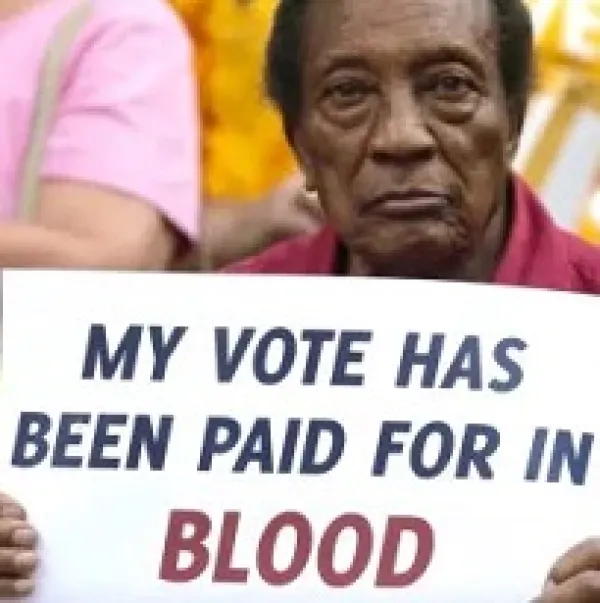
The Supreme Court decision blessing the purge of half a million voters in Ohio is NOT the last word.
On Monday, the renowned law firm of Mirer Mazzocchi Julien of New York will serve a 90-day notice on Jon Husted, the Secretary of State of Ohio, of our intent to file suit in federal court unless we receive complete information on each of the hundreds of thousands of voters removed from the voter rolls.
We have already filed a demand for information on Kris Kobach, the éminence grise behind Ohio and other mass purges nationwide, to open his purge program files to us. We are joined in this demand by the ACLU of Kansas.
What we can do
The US Supreme Court (by the usual 5-4) has certified Ohio’s Jim Crow stripping of more than a million mostly black and Hispanic citizens from the 2018 voter registration rolls. Unless the Democrats effectively respond, a GOP victory in the 2018 mid-term election may be a done deal.
The decision approves Ohio’s race-based assault on the right to vote. Secretary of State Jon Husted has been stripping citizens who don’t vote in consecutive federal elections. His office mailed some 1.5 million queries to registered voters. He got back fewer than 300,000 responses – and then stripped some 1.2 million voters from the computer files.
Husted (now running for lieutenant governor) says he’s sent voters a notice after they skip a single federal election. If they don’t vote or respond in the next four years, they lose their ballot.
Court documents confirm that those eliminated are mostly urban blacks and Hispanics in mostly Democratic districts. Voters in rural Republican districts are often not queried, and their registration rolls are not stripped.
Technology has bestowed a stunning twist of fate in the arcane world of counting how America votes.
A decade ago, activists railed against private companies who made the computer-driven “black boxes” that tabulated election results. That opacity, to protect their trade secrets, fueled sore losers, conspiracy theories and thwarted journalistic investigations of miscounts or tampering.
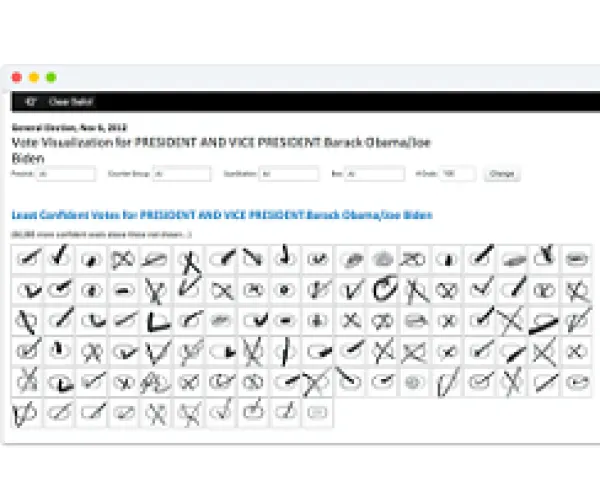
But today, the voting machine industry’s newest devices are producing digital images of individual paper ballots, accompanied by devices that mark the ballot or its image, and include audit systems that can trace disputed ballots back to their precincts—by using technology that’s akin to how banks allow smart phones to securely deposit checks.
These newest systems vary—some are better than others. Yet taken together, they suggest technology in on the brink of ushering in a new era of vote counting transparency. This is before winners are certified, not afterward as an academic exercise or audit.
FOR IMMEDIATE RELEASE
Husted, Counties Sued to Prevent Planned Destruction of Election Records
Columbus, OH, April 20, 2018 – Ohio voters are suing Secretary of State Jon Husted and the Boards of Election of Franklin and Cuyahoga in order to protect key election materials from next month’s primary election that they say the counties plan to destroy.
At issue are the “digital ballot images” created by the digital scanners that tabulate votes on paper ballots. Digital scanners are in use in 15 counties, including Cuyahoga and Franklin. These records are essential for verifying the accuracy of the election results, according to the suit.
“We’ve had indications that most of the counties that use this technology are following the law and preserving the digital ballot images,” said attorney Robert J. Fitrakis of Columbus, who filed the suit yesterday in the Ohio Supreme court. “As a precaution, we’re seeking a court order that these crucial records be protected in every county where they exist.”
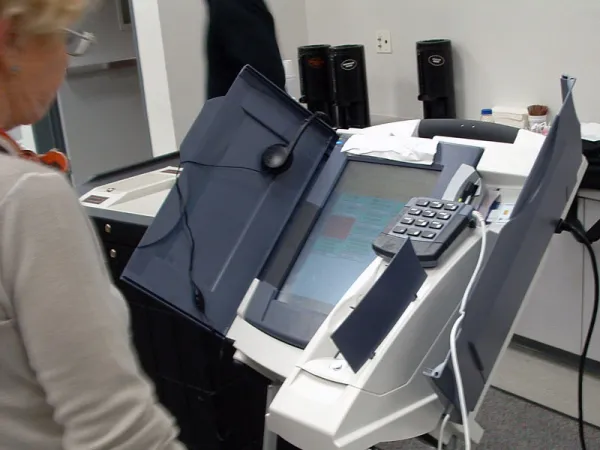
Ohio’s decision to buy new voting machines will make the difference between hackable -- or less-hackable elections.
Let’s begin by stating the obvious: All computer voting machines can be hacked!
We remember when Ohioans witnessed their votes jumping from John Kerry to George Bush on voting machines in Youngstown during the 2004 election. Voters saw their Kerry selection disappear during the infamous “Franklin County fade” on electronic voting machines in that election as well. Ohio’s former voting machine company, Diebold admitted its system accidentally knocked 10,000 registered voters off the rolls.
Ohio’s previous Secretary of State Jennifer Brunner conducted the seminal Everest Study of Ohio’s voting machines in 2007 and found that all of them had security problems. The study concluded that: “Unfortunately, the findings in this study indicate that the computer-based voting systems in use in Ohio do not meet computer industry security standards and are susceptible to breaches of security that may jeopardize the integrity of the voting process.”
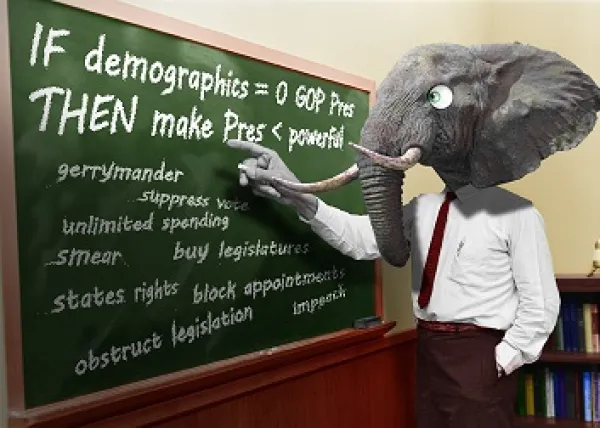
The US Supreme Court may be about to make a second Trump term inevitable.
The nine "Justices" have just heard oral arguments in an Ohio voter registration case. If their decision goes with Secretary of State Jon Husted, it would mean Republicans like him throughout the United States will be able to scrub from the voter rolls millions of citizens merely because they are suspected of wishing to vote Democrat.
In Ohio alone, millions of Ohio voters have tried to vote on Election Day over the past four presidential elections, only to find their names were erased from the pollbooks.
What's technically at stake is whether the federal government has the right to demand fairness in purging voter registration rolls. Or will the secretaries of the various states be free to purge whomever they want.
In other words, it's supposedly a "state’s rights" case.
But this is a country where an Attorney-General who fought for state’s rights to avoid accepting racial integration is now overriding the explicit choice of some thirty states to enjoy legal marijuana.
Resident Donald Trump’s highly criticized so-called Election Integrity Commission, looking into supposed “voter fraud,” was disbanded Wednesday, January 3. The Commission was forged by fire in the tweets of Trump and his bizarre claim that Hillary Clinton’s more than 3 million popular vote win was based on votes by illegal immigrants.
Recently the Commission was in a spat with a dozen or so states when it demanded they submit all of their voter data to them. including partial voter Social Security numbers. Matthew Dunlap, Maine’s Secretary of State and Commission member, sued the commission claiming he was being kept in the dark on the group’s activities.
Ohio’s former Secretary of State Ken Blackwell’s appointment to the Commission resulted in open derision since he best known for suppressing votes in the notorious 2004 Ohio presidential election. Before Election Day, Blackwell rejected voter registration forms that weren’t submitted on 80-bond paper used prior to the advent of computers, instead of today’s standard 20-bond paper.
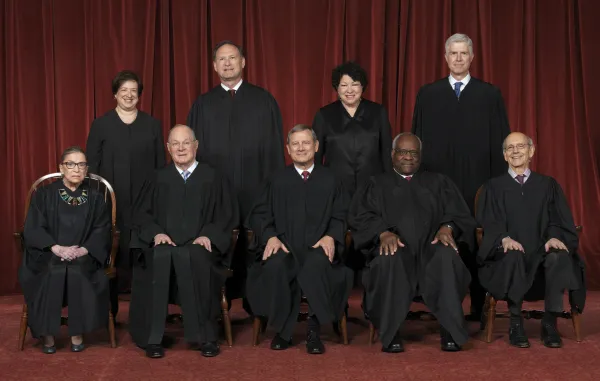
Millions of Ohio voters have tried to vote on Election Day over the past 15 years only to find their names were erased from the pollbooks.
The American Civil Liberties Union (ACLU) brought suit against the State of Ohio and Ohio Secretary of State Jon Husted to protect voter’s rights to remain registered. At the crux of the ACLU’s lawsuit were 385,065 registered Ohioans who were refused absentee ballots in 2016 because they had failed to vote in the 2012 or 2014 federal elections.
The United States Supreme Court will now decide whether voting in Ohio is a constitutional right like free speech or a more limited right controlled by the Secretary of State’s office. Oral arguments begin on Wednesday, January 10.
While the whole world watches Tuesday’s Alabama US Senate election, race-based battles behind the scenes could decide the outcome.
They focus on likely stripping of voter rolls to prevent African-Americans from casting their rightful ballots , and flipping the electronic outcome should that prove insufficient.
But election protection activists have just won a major court victory that could make electronically flipping the election more difficult. An in-depth feature will follow on that tonight.
The national Democratic Party has poured significant resources into this race. We hope it will provide careful scrutiny on whether legitimate citizens are allowed to vote, and on how the votes are actually counted.

While the whole world watches Tuesday’s Alabama US Senate election, race-based battles behind the scenes could decide the outcome.
They focus on likely stripping of voter rolls to prevent African-Americans from casting their rightful ballots, and flipping the electronic outcome should that prove insufficient.
The national Democratic Party has poured significant resources into this race.We hope it will provide careful scrutiny on whether legitimate citizens are allowed to vote, and on how the votes are actually counted.
In particular, we urge that there be no definitive concession shy of a full recount, and of public hearings on who was allowed the right to vote and who was denied it, including access to regular rather than provisional ballots.
Three key voter access issues include: