
Peace

1. Reports on the climate collapse have stopped in some cases the nonsense talk about needing the United States to "lead," and even gone beyond urging it to get out of last place, and begun demanding that it do its fair share to undo its share of the damage. That's the same thing we need on militarism, when U.S. weapons are on both sides of most wars, almost all foreign bases are U.S. bases, and most people in the U.S. can't begin to name its current wars, drone murders, or nations with U.S. troops in them. We saw this past year that moving even 10% out of militarism, even explicitly to address a health crisis killing huge numbers of people in the United States, was too great a blasphemy. The biggest chance of reducing militarism, winding back the nuclear doomsday clock, and funding a serious Green New Deal is to make demilitarization part of a Green New Deal. That means telling your misrepresentative and senators that, and telling every environmental organization that. Here are some resources to help:

No matter who ends up winning Senate confirmation for top positions on President Biden’s “national security” team, an ominous dynamic is already underway. Some foreign-policy specialists with progressive reputations are voicing support and evasive praise for prospective Cabinet members -- as though spinning through revolving doors to broker lucrative Pentagon contracts is not a conflict of interest, and as though advocating for an aggressive U.S. military posture is fine.
Rationalizations are plentiful, but the results are dangerous. It’s an insidious process -- helping to set low standards for the incoming administration. Enablers now extol potential Cabinet picks who’ve combined pushing for continuous war and hugely expensive new weapons systems with getting rich as dealmakers for the military-industrial complex.
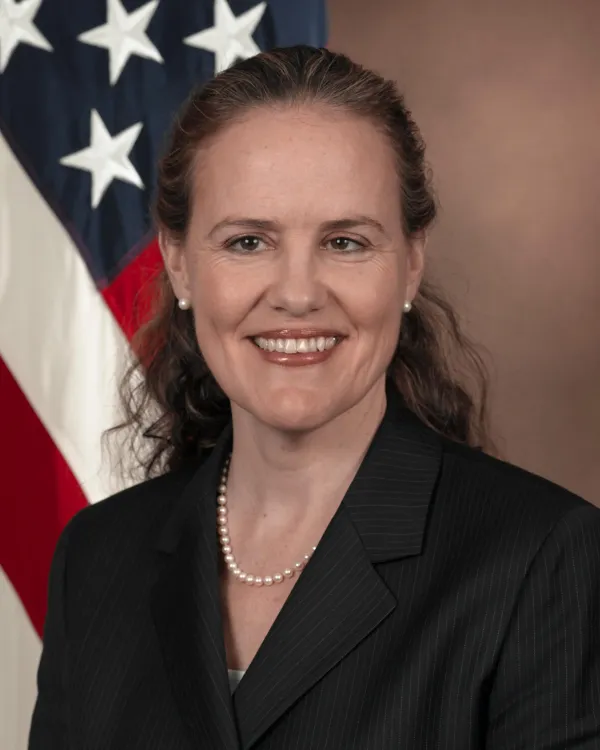
By all accounts, the frontrunner to be Joe Biden’s pick for Secretary of Defense is Michèle Flournoy. It’s a prospect that should do more than set off alarm bells -- it should be understood as a scenario for the president-elect to stick his middle fingers in the eyes of Americans who are fed up with endless war and ongoing militarism.
Warning and petitioningBiden to dissuade him from a Flournoy nomination probably have scant chances of success. But if Biden puts her name forward, activists should quickly launch an all-out effort to block Senate confirmation.
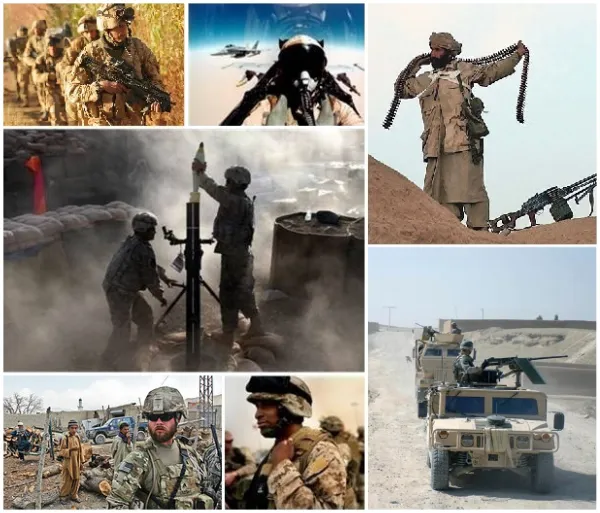
So here’s an odd, mostly overlooked scrap of recent news: Donald Trump wants to end the wars in Afghanistan and Iraq before he leaves office, and is expected to announce a drawdown of troops in both countries.
Currently there are approximately 4,500 troops in Afghanistan and 3,000 in Iraq. The drawdown would leave 2,500 troops in each country.
Even Mitch McConnell is aghast!
In a speech from the Senate floor this week, he said: “We’re playing a limited — limited — but important role in defending American national security and American interests against terrorists who would like nothing more than for the most powerful force for good in the world to simply pick up our ball and go home.”
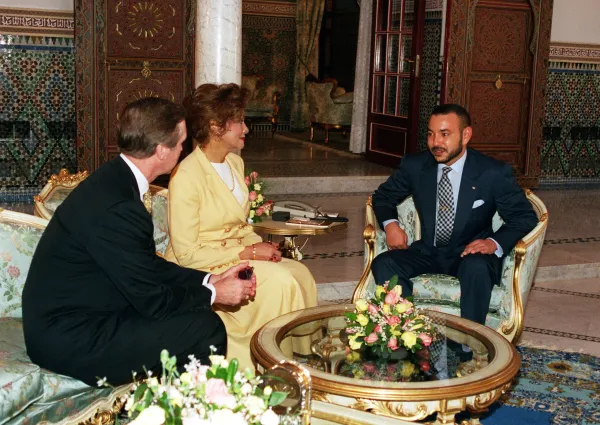
Secretary of Defense William S. Cohen (left) and his wife Janet Langhart Cohen (center) meet with King Mohammed VI, of Morocco, at his palace in Marrakech, on Feb. 11, 2000. Cohen and the King agreed to open an expanded security and defense dialogue, and discussed ways that Morocco could expand its leadership role in promoting regional stability in the Mediterranean and on the African continent. DoD photo by R. D. Ward. (Released)
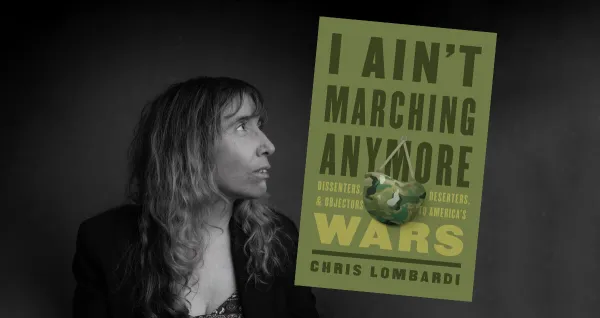
Chris Lombardi’s fantastic new book is called I Ain’t Marching Anymore: Dissenters, Deserters, and Objectors to America’s Wars. It’s a wonderful history of U.S. wars, and both support for and opposition to them, with a major focus on troops and veterans, from 1754 to the present.
The greatest strength of the book is its depth of detail, the rarely heard individual accounts of war supporters, resisters, whistleblowers, protesters, and all of the complexities that catch so many people in more than one of those categories. There’s an element of frustration for me, in that one hates to read about generation after generation growing up believing war is good and noble, and then learning that it isn’t the hard way. But there’s also a positive trend discernable through the centuries, a growing awareness that war is not glorious — if not the wisdom that rejects all war, at least the notion that a war must somehow be justified in some extraordinary way.

Here’s a piece of paradoxical news that puts even the looming U.S. presidential election in perspective: Nuclear weapons are now (or soon will be) . . . good Lord, illegal.
Armageddon is against the law!
Well, sort of. And the Trump administration doesn’t agree. Indeed, no nuke-armed nation has, as far as I can tell, anything but contempt for this infringement on its right to blow up the world (only if necessary, of course). War and peace, it seems, exist in parallel universes.

If you do a web search for images of “Nazi salute” you find old photos from Germany and recent photos from the United States. But if you search for images of “Bellamy salute” you find countless black-and-white photographs of U.S. children and adults with their right arms raised stiffly out in front of them in what will strike most people as a Nazi salute. From the early 1890s through 1942 the United States used the Bellamy salute to accompany the words written by Francis Bellamy and known as the Pledge of Allegiance. In 1942, the U.S.
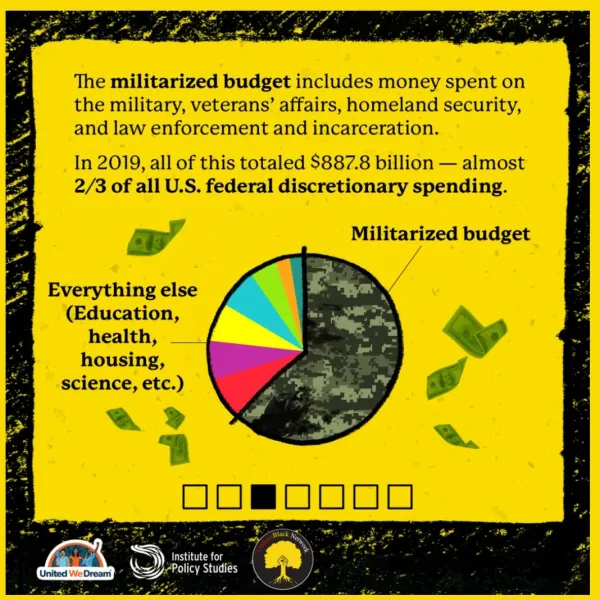
Over half of the money that Congress decides what to do with every year is for wars and war preparations, year after year.
When you add in police and prisons, and the militarization of police and prisons — and of borders and airports — and the Veterans Administration, you’re talking about two-thirds of the money.
So the big question is, of course, why do I hate Veterans?
Oh, go Dick Cheney yourself. I support universal free healthcare and education and guaranteed retirement and childcare and transportation and sustainable energy for every human being, veteran or not.
So the serious question is how the hell am I going to pay for that?
Well, with a fraction of what’s spent now on the militarized budget, of course.
Plus a fraction of what should be taxed from corporations and the ultra rich.
But what about the non-discretionary spending?
What about it? Much of it is for Social Security and healthcare, but a big chunk of it is for militarism — including debt for past wars.
So really I think we’re left with: why do I hate the troops?
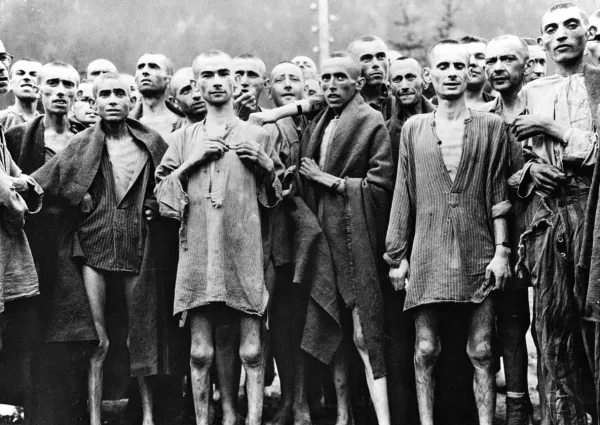
Excerpted from Leaving World War II Behind.
If you were to listen to people justifying WWII today, and using WWII to justify the subsequent 75 years of wars and war preparations, the first thing you would expect to find in reading about what WWII actually was would be a war motivated by the need to save Jews from mass murder. There would be old photographs of posters with Uncle Sam pointing his finger, saying “I want you to save the Jews!”