
The Free Press is bringing back a Reviews section after some absence. We hope to review plenty of events around town. Check back frequently and if what\'s going on is any good.
Arts & Culture
Image

What I loved about director/co-writer Hari Sama’s This is Not Berlin is that it immersed me (and I suspect most grinning Gringos and other non-Mexicans) into a world I’d never encountered before. Set in Mexico City in the mid-1980s, Sama depicts the punk rock scene, counterculture and gay “subculture” of the Mexican capital of that era. It reminded me of the ultra-cool Andy Warhol “Factory” world in Manhattan during the 1960s and 1970s, with the kind of wild parties that Rico Salvatore Rizzo, aka Ratso (Dustin Hoffman), walked out of in 1969’s Midnight Cowboy, denouncing the revelers as “wackos, they’re all wackos.”
Image
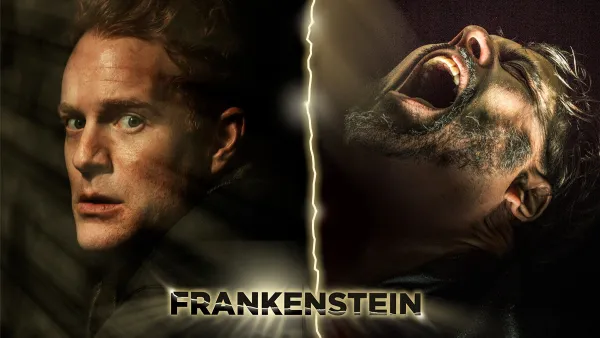
A Noise Within’s Frankenstein is one of the most unique plays I’ve ever seen. Using British playwright Nick Dear’s adaptation, the drama opens with one of the best “jump cuts” I’ve seen since that ape-like being in 2001: A Space Odyssey tossed his bony weapon into the air, which transitions to a spacecraft in the heavens. Dispensing with lots of exposition this stage production cuts right to the chase, presumably because most theatergoers are already familiar with the world famous story, as related in Mary Wollstonecraft Shelley’s immortal (no pun intended) 1816 Gothic novel, and in countless retellings, most notably in the still unsurpassed 1931 James Whale movie of the same name starring Boris Karloff.
Image
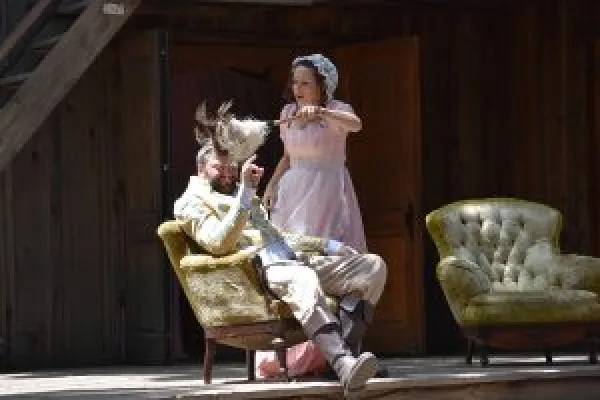
Will Geer’s Theatricum Botanicum is a Shakespearean repository of culture, and with their delectable production of the Bard’s comedy Twelfth Night this Topanga troupe has outdone itself in letting its collective hair down. If WGTB’s version of Thornton Wilder’s The Skin of Our Teeth borrows from burlesque’s conventions, Twelfth draws heavily from slapstick to produce a crowd-pleasing spectacle.
For some reason, hidden and mistaken identities are a long standing plot and character theatrical device dating back to the Greeks. Here, following a shipwreck the youthful Viola (Willow Geer) contrives to disguise herself as a eunuch, calling herself “Cesario.” Camouflaged as a male, she becomes an envoy for Duke Orsino (Max Lawrence, who was so great as Boxer in WGTB’s staging of Orwell’s Animal Farm a while back) in his campaign to woo Olivia (Christine Breihan), a countess.
Image
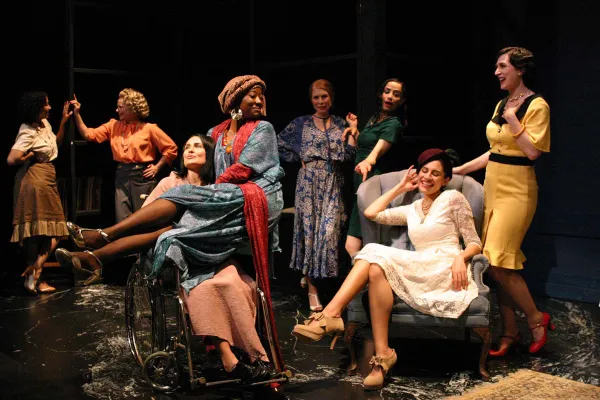
Originality is among those attributes I admire and cherish most in the arts, and Maria Irene Fornes’ Fefu and Her Friends is very singular on several fronts. First of all, the Cuban-born, Obie Award-winning playwright’s characters are all female, and this is far less common than mixed gender or all male casts, such as in Jason Miller’s That Championship Season, first produced in the 1970s, as was Fefu. This casting and the fact that the bard is a woman indelibly stamps Fefu with a distinctly feminist point of view. As such, Fefu deals with gender issues, sexual politics, as well as with same sex relationships.
Image
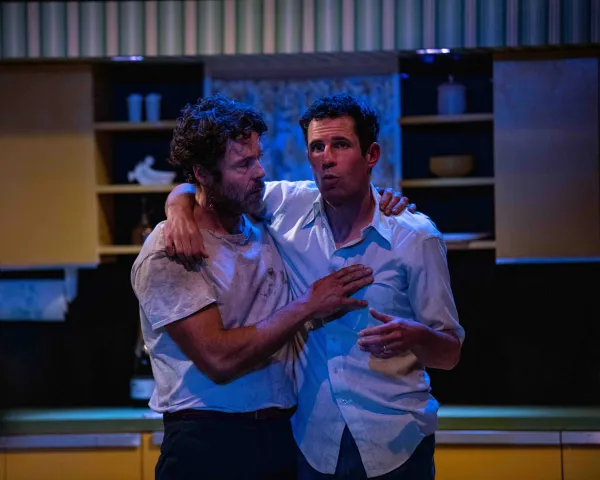
From almost the split second when the proverbial curtain lifts on Danny Cistone’s realistic SoCal house set, Vs. Theatre Company’s production of Sam Shepard’s True West crackles with tension. In this gripping, grim drama that’s so edgy I sat on the edge of my seat throughout the two-acter, two estranged brothers encounter one another for the first time in quite a spell at their mother’s (stage/screen stalwart Carole Goldman) home located near the Inland Empire while dear old ma visits Alaska.
Although the younger of the two, Austin (Johnny Clark, Vs. Theatre Company’s Artistic Director and co-founder) seems to have his shit together. In addition to being a family man, Austin is a reasonably successful screenwriter, who has a major pending deal with Hollywood producer Saul Kimmer (stage and screen veteran David Starzyk).
Image

Hobbs & Shaw is an action-packed spin-off from the Fast & Furious film franchise, with Dwayne Johnson (aka The Rock) and Jason Stratham reprising their roles from that highly kinetic cinematic series as the titular Luke Hobbs and Deckard Shaw. There are plenty of explosions, car chases, combat, death defying stunts that makes Evel Knievel look like a wuss and the like in this 2 hour and 15 minute ultra-violent, noisy movie-movie. In H&S, what Hitchcock called the MacGuffin - the plot device that provides the cosmic rationale for all of the story’s frenetic derring-do - is a serum with a virus that will wipe out humanity.
Image
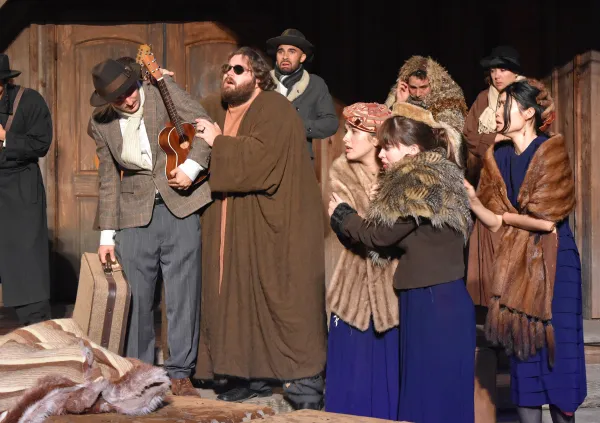
Three-time Pulitzer Prize winner Thornton Wilder’s perplexing play The Skin of Our Teeth is arguably a precursor to the Theatre of the Absurd. It opened on Broadway in 1942 as America entered World War II and Wilder described it as “the history of mankind in a comic strip.” Speaking of strips, the surreal two-acter borrows from Burlesque’s bump-and-grind conventions, and in the production currently on the boards at Will Geer’s Theatricum Botanicum, Willow Geer portrays a buxom, ginger-haired seductress gloriously clad much of the time in a cross between a French maid’s outfit and lingerie. Her character is named Sabina (rhymes with…?), and she alternates between being a housekeeper, beauty queen and warrior, often with great comic panache.
Image

Stéphane Brizé’s award-winning At War (En Guerre) is a French
feature about unions, strikes and class struggle being released in
America shortly after Bastille Day, which commemorates that “other”
French Revolution. In this movie a German-owned company reneges
on promises to keep a factory open in an economically depressed
region of France, despite the workers’ sacrifices, agreeing to cutbacks
on wages and benefits, plus the firm’s receiving of subsidies and tax
credits from the French government. The “problem” is that although
the factory makes a profit, it is not profitable enough for shareholders
obsessed with “competivity” in our increasingly globalized planet.
In the workers’ fight to prevent the plant from closing and not lose
their jobs the proletarians resort to industrial actions that become
increasingly militant, including walking off the job, sit-down strikes,
occupations, etc. The failure of the French government and courts to
decisively support the strikers pushes them towards more direct
action. At one point the German CEO is roughed up after a failed
Image
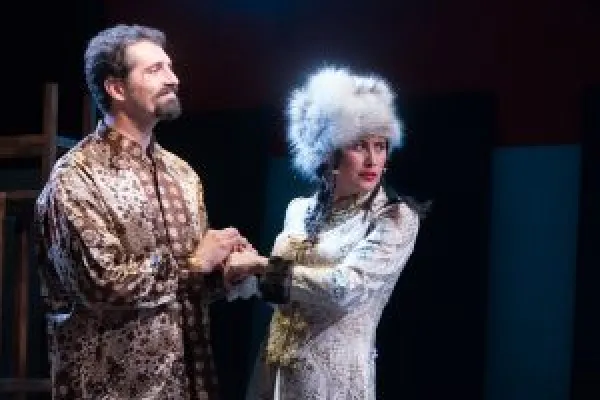
It’s Karl Marx meets the Marx Brothers in Antaeus Theatre Company’s adaption of Bertolt Brecht’s 1944 play The Caucasian Chalk Circle. Brecht, who wrote The Threepenny Opera and Mother Courage, is best known for his leftwing agitprop. But many forget what Antaeus wisely remembers - while the German playwright may have been a master polemicist and propagandist (often against the master race) Brecht also had a caustic wit which reaches new heights of Marxist mirth in this production at the Kiki & David Gindler Performing Arts Center.
Image
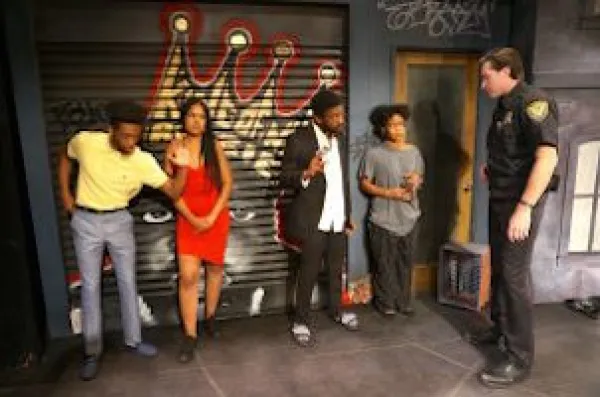
As earthquakes struck SoCal a theatrical aftershock rocked the L.A. stage on July 6 with the West Coast premiere of Scraps. Geraldine Inoa’s brilliant, powerful play is at the cutting edge of the stage and screen cycle of productions reacting to the surge of police and vigilante killings of African Americans and/or the judicial system’s unjust mistreatment of Blacks. And Scraps is among the best of these works protesting racial injustice and inequity perpetrated (and perpetuated) by those perps/twerps - the “men” in blue and in robes (sometimes black, sometimes white).
Inspired by Michael Brown’s murder, Inoa’s Scraps focuses on how these injustices reverberate in the minds and lives of loved ones left behind after these discriminatory slayings occur. This may surprise some because according to racial tropes, African Americans aren’t sophisticated enough to have unconscious minds, but Inoa begs to differ.