
Your source for alternative media coverage of the 2008 election alongside the 2004 elections and the related voter irregularities in Ohio.<br><br>Additional articles about the elections by <a href=http://www.freepress.org/columns/display/3>Bob Fitrakis</a> and <a href=http://www.freepress.org/columns/display/7>Harvey Wasserman</a> are in the <a href=http://www.freepress.org/columns>columns</a> section.
<br><br>
Those interested in contributing statistical skills to the project may want to contact <a href=mailto:truth@freepress.org>The Free Press</a> and <a href=http://uscountvotes.org target=usvotes>uscountvotes.org</a>.
Election Issues
Image
Washington, D.C., March 15, 2016 – The nationwide nonpartisan Election Protection voter hotline,  866-OUR-VOTE received more 2,100 calls as voters in five states headed to the polls during March 15 presidential preference primaries as of 6 p.m. EDT. The hotline received a steady stream of calls throughout the day with voters seeking information and requesting assistance on a range of issues that resulted from poll worker misinformation, voter ID requirement implementation, long lines and last minute polling place changes.
Image
A visit to the Driving Park Library polling site in Franklin County found that the presiding judge said that there the primarily black precincts had 24 provisional votes, between 5-10% of total votes at approximately 1pm.
At the polling site at the King Arts Complex in Columbus’ inner city, the precinct judge reported that four voting machines would not boot up at the beginning of the day and the BOE had to send in technicians. The machines were running by the time the polls opened. She reported between 30-40% provisional votes by approximately 1:30pm.
A forwarded report to the Free Press noted that in Bexley, Ohio, a voter was told that there was no Green Party ballot.
Image
These are the initial voting problems reported to the Free Press.
Reports came in during early voting, prior to primary Election Day:
* The Franklin County Board of Elections (BOE) (Columbus) "accidentally" mailed completed absentee ballots to some voters. The Franklin County BOE reported that it would be contacting those voters.
* An Election Protection worker attempted to see all three Party sample ballots - Democrats, Greens and Republicans. A Franklin County BOE absentee ballot official incorrectly informed her that the Green Party did not have a ballot. The problem was corrected by a BOE supervisor.
* An incumbent Franklin County Green Party Central Committee member and candidate on the Green Party primary ballot went in the Franklin County BOE early voting site and asked for a Green Party ballot. She was initially told there was no Green Party ballot. She had to demand they find and give her a Green Party ballot.
* The Free Press got a call from a Franklin County voter reporting that the home page of the Franklin County BOE did not list early voting hours for the Saturday, Sunday and Monday prior to the Tuesday, March 15 Election Day.
Image
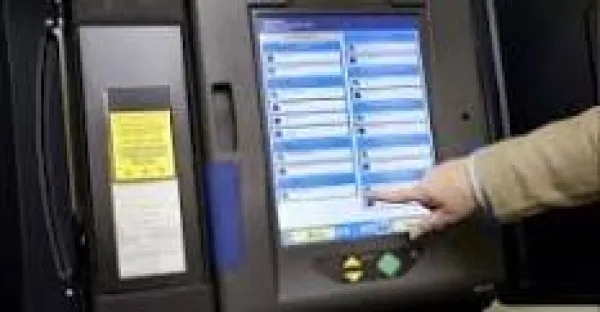
Washington, D.C., March 1, 2016 – The nationwide nonpartisan Election Protection voter hotline, 866-OUR-VOTE received more than 2,000 calls as voters in 12 states made their voices heard during the Super Tuesday presidential preference primaries and caucuses. The hotline received a steady stream of calls throughout the day with voters seeking information as well as assistance on a range of issues resulting from poll worker misinformation, voter ID problems, overcrowded polls, long lines and ballot shortages.
Image
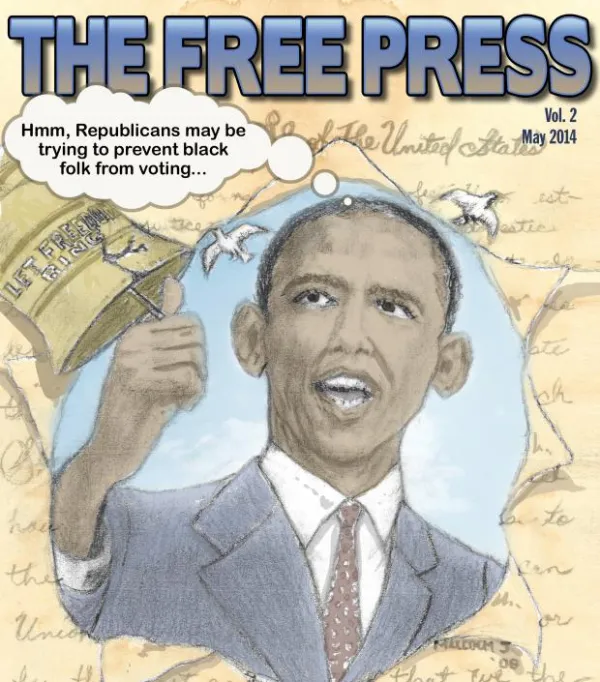
As the New Hampshire primary lurches toward the finish line, the reality of electronic election theft looms over the vote count.
The actual computer voting machines were introduced on a grand scale in New Hampshire’s 1988 primary. The godfather was George H.W. Bush, then the Vice President. As former boss of the CIA, Bush was thoroughly familiar with the methods of changing election outcomes. The Agency had been doing it for decades in client states throughout the world.
In the Granite State, Bush was up against Bob Dole, long-time Senator from Kansas. Dole was much loved in hard-core Republican circles. But Bush had an ace-in-the-hole. For the first time, the votes would be cast and counted on electronic voting machines, in this case from Shoup Electronics.
Image
 ernie Sanders has shown in Iowa that he’s a viable candidate … and more. Considering Bernie was down 50 points just a while ago, Iowa has sent a clear signal that this campaign must be taken seriously.
But the terrain will quickly shift. Bernie will obviously do well in New Hampshire. Then the race will move to southern and bigger states, where Hillary may have an edge.
But we’re not talking about demographics. The real terrain shift that concerns us is from a caucus state to ones where the votes are counted on electronic voting machines.
The key strategy in question is “strip and flip,” i.e., the stripping of electronic registration lists, and then the flipping of the vote count on machines that have no reliable system of verification.
The “strip & flip” realities are simple enough:
STRIP:
Image
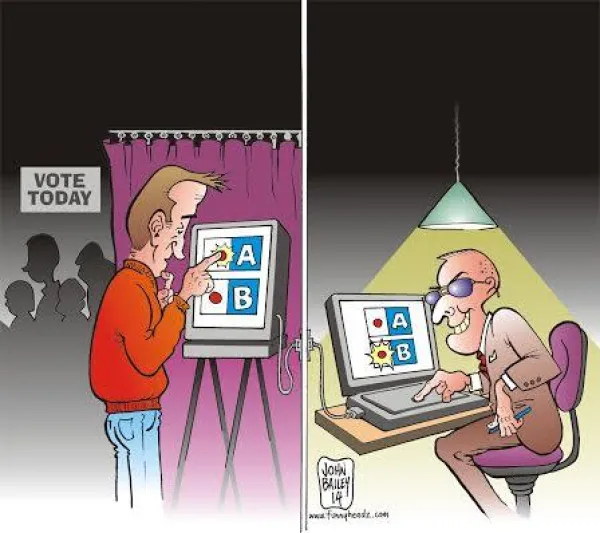
As the 2016 election approaches, we must remember that our electronic voting system as it currently stands is thoroughly rigged. The entire outcome can be flipped with a few late night keystrokes, as was done in Ohio 2004. This year least 80% of the nation’s votes will be cast on electronic machines whose outcome can be altered by a governor and secretary of state with just a few keystrokes, and without detection. There is a way—-we call it the “Ohio Plan”—-by which we can attain a fair and reliable vote count. The Ohio Plan is this: Voter registration must be universal and automatic for all citizens as they turn 18; Electronic poll books are banned, with all voter registration records maintained manually; All elections happen over a 4-day weekend—-Saturday, Sunday, Monday, Tuesday—-which together comprise a national holiday, preferably around Veterans Day in November.
Image
Official Vote Tally on Ohio’s Pot Issue Deemed "Statistically Impossible"
The “stolen election” controversy over this month’s officially defeated Ohio pot legalization referendum has gone to a new level.
“The results are not only impossible but unfathomable,” stated Ron Baiman, Assistant Professor of Graduate Business Administration at Benedictine University, where he teaches economics and statistics.
The Columbus Free Press asked Baiman to calculate the odds of the official vote count of Ohio’s Issue 3, to legalize marijuana, being correct – compared to the tracking polls charting voter preference leading up to this year’s November election. The Free Press supplied Baiman with poll results taken prior to the election by noted pollster Jon Zogby.
The polls leading into the November 3 vote showed the referendum passing. But the official results claim it lost by 2:1.