
Your source for alternative media coverage of the 2008 election alongside the 2004 elections and the related voter irregularities in Ohio.<br><br>Additional articles about the elections by <a href=http://www.freepress.org/columns/display/3>Bob Fitrakis</a> and <a href=http://www.freepress.org/columns/display/7>Harvey Wasserman</a> are in the <a href=http://www.freepress.org/columns>columns</a> section.
<br><br>
Those interested in contributing statistical skills to the project may want to contact <a href=mailto:truth@freepress.org>The Free Press</a> and <a href=http://uscountvotes.org target=usvotes>uscountvotes.org</a>.
Election Issues
Image

I get it: We all must vote by mail—or we die. There is really no other safe choice.
But there is much to fear, especially for minority and young voters, with a switch to all-mail voting—unless our broken absentee ballot system is fixed.
Here’s what the “Go Postal” crowd doesn’t tell you: In 2016, 512,696 mail-in ballots—over half a million—were simply rejected, not counted. That’s official, from the federal Elections Assistance Commission (EAC).
But that’s just the tip of the ballot-berg of uncounted mail-in votes. A study by MIT, Losing Votes by Mail, puts the total loss of mail-in votes at a breathtaking 22%.
Move to 80% mail-in voting and 25 million will lose their vote.
And not just anyone’s mail-in ballots are dumped in the electoral trashcan. Overwhelmingly, those junked are ballots mailed by poorer, younger, non-white Americans.
Senator Amy Klobuchar’s proposed bill takes baby steps to expanding vote-by-mail protection but will barely bite into the 22% loss of votes especially among minorities.
Image
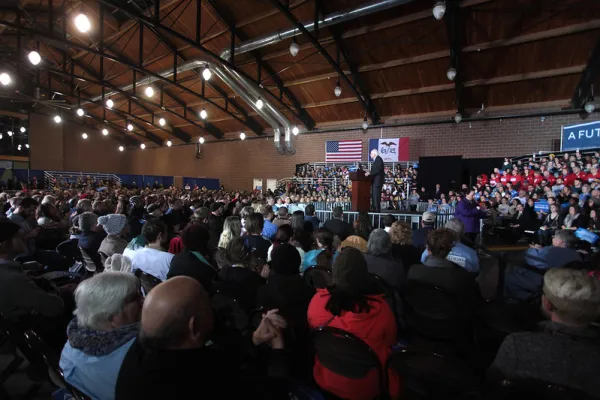
“In a dark time,” poet Theodore Roethke wrote, “the eye begins to see.”
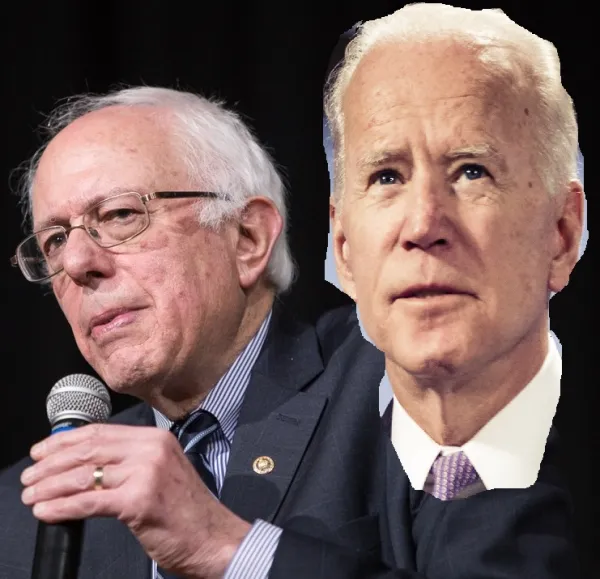
No matter who wins the Democratic presidential nomination, many millions of people will refuse to unsee what has become all too clear. On the verge of spring 2020, we can see what we’re up against:
•A crowing media establishment, eager to relegate the Bernie Sanders campaign to the political margins.
•A gloating Democratic Party establishment, glad to rally around Potemkin candidate Joe Biden and extol his carefully crafted façade.
•Overall, interlocking systems based on greed and corporate power instead of shared resources and genuine democracy.
Image
Norman Solomon is cofounder and coordinator of RootsAction.org as well as founder and director of the Institute for Public Accuracy. He is the author of a dozen books including War Made Easy and Made Love, Got War. He has written op-ed pieces for almost every large daily U.S. newspaper and appears often on a wide range of radio and TV outlets. We discuss the U.S. presidential election.
Total run time: 29:00
Host: David Swanson.
Producer: David Swanson.
Music by Duke Ellington.
Download from LetsTryDemocracy, or from Internet Archive.
Pacifica stations can also download from Audioport.
Syndicated by Pacifica Network.
Image
Posted on March 4, 2020 by Theodore de Macedo Soares — 25 Comments ↓
Please share this article:
By Theodore de Macedo Soares
Image

A gush of corporate relief fills the airwaves as Super Tuesday becomes history. A progressive wave was not electorally visible as the Democratic status quo consolidated itself behind Joe Biden and won nine or maybe ten states.
I was feeling a lot more hope when Super Tuesday began than I’m feeling a day later, so the need right now is to regroup.
Freelance writer and organizer Kate Aronoff, speaking on a panel of observers at Democracy Now! as the election results unfolded, made an important point in this regard: “The Democratic establishment is going against the future. . . . There is no normal anymore!”
Image
A review of Michael Bloomberg’s political career should not be limited, I think, to the fact that he has the debating skills of a baked potato. Nor does it matter much that he focuses his sales pitch on being a great “manager” but clearly can’t manage to hire anyone to tell him he has to prepare for a debate. His use of non-disclosure agreements to hide undesirable stories deserves the criticism it’s getting, but just begins to scrape the toxic moldy surface.
My colleagues at RootsAction.org have looked into Bloomberg’s record in some depth and are organizing against his campaign in early primary states. Let’s review just a few of the facts.
Image
Elections, I think most of us can agree, usually bring out the idiocy, superficiality, and illogic in everyone who can muster any. Imagine supporting, as many did, Sanders and then Trump because they were both “outsiders.” On Tuesday, I heard somebody on CNN announce that Sanders and Klobuchar were both “change candidates” (because you’d have to change every bit of the platform of one of them to match that of the other?). Tokenism no longer embarrasses voters or even the candidates who openly campaign on it. When voters are asked on television how they choose a candidate, they talk about temperament, personality, debating skills, and intelligence.
Image
This weekend, Pete Buttigieg told supporters that he became a viable candidate for president “on the strength of our vision” and “the urgency of our convictions.” Such rhetoric fits snugly into a creation myth about his campaign that Buttigieg has been promoting since early 2019.
Summing up the gist of that myth, Buttigieg began this year by standing at a whiteboard and looking into a camera while he talked about the genesis of his run for the presidency. “We launched as an exploratory committee, not even a full year ago, with a few volunteers, zero dollars in the bank,” he said -- and “without the personal wealth of a millionaire or a billionaire.”
Image
[From Noam Chomsky, Bill Fletcher, Barbara Ehrenreich, Kathy Kelly, Ron Daniels, Leslie Cagan, Norman Solomon, Cynthia Peters, and Michael Albert]
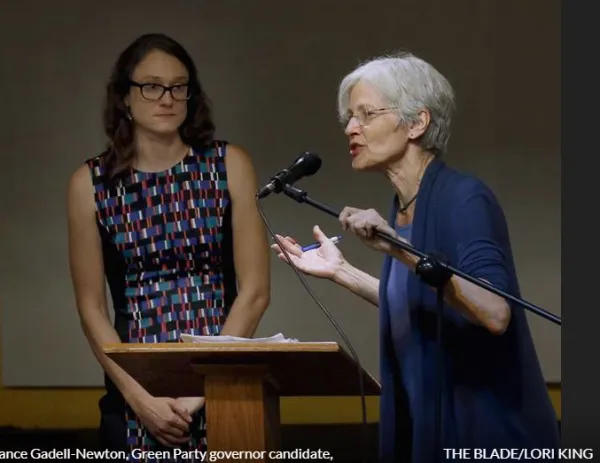
As the 2020 presidential election approaches the Green Party faces the challenge of settling on a platform, choosing a candidate for president, and deciding its campaign strategy. In that context, Howie Hawkins, a contender for Green Party presidential candidate, recently published a clear and cogent essay titled “The Green Party Is Not the Democrats’ Problem.” It represents a precedent Green Party stance which may guide Green campaign policy. We agree with much, but find some ideas very troubling.