
The Free Press is bringing back a Reviews section after some absence. We hope to review plenty of events around town. Check back frequently and if what\'s going on is any good.
Arts & Culture
One would think that a documentary titled Stuntman would be an action-packed look at an intriguing, exciting profession. 1978’s Hooper, co-starring the recently deceased Burt Reynolds and Sally Field, and 1980’s The Stunt Man with Peter O’Toole were both features inspired by these daredevils and their derring-do. But director Kurt Mattile’s (2018’s well-received Poly-pop doc Bosko and the Rebirth of Tiki, which sold out at the Egyptian Theatre during its annual Tiki Night) nonfiction film about Eddie Braun and his whimsical crusade to execute Evel Knievel’s botched 1974 effort to cross the Snake River Canyon in a rocket-like contraption is a plodding, poorly paced piece.
Image
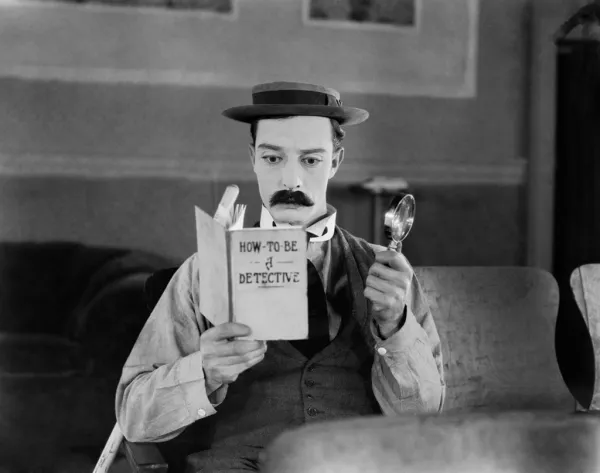
Peter Bogdanovich’s documentary The Great Buster: A Celebration is must-see cinema for all lovers of not only the eponymous Buster Keaton, but of film history, biography, silent movies, comedy and anyone who just loves to laugh out loud. In his loving look at a legend, Bogdanovich chronicles Keaton’s being born to Vaudevillian parents while they were on the road and his childhood spent onstage as part of the family business in variety acts in venues across America.
The film follows Keaton as his brand of physical comedy inevitably led to a career on the silent screen, first in two reel shorts under the tutelage of Fatty Arbuckle then on to starring roles in feature length films he directed and wrote (not that most of his own movies actually had full-blown screenplays per se). Once talkies took over, the comic famed for his falls hit the skids and Bogdanovich reveals Keaton’s trials and tribulations on- and offscreen.
Image
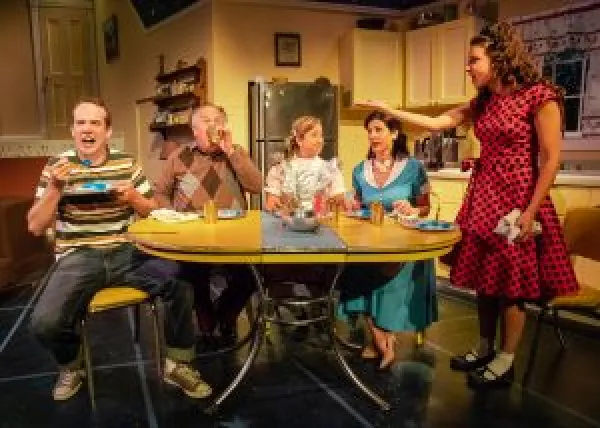
Genre spoofs are among my favorite type of productions, the paragons being Mel Brooks’ parodies, such as his loopy lampooning of the Western in Blazing Saddles. In John O’Keefe’s wonderfully wildly witty and wry All Night Long the conventions of 1950s/1960s sitcoms such as The Donna Reed Show are raked over the comedic coals as America’s nuclear family is exploded.
Ironically, before the eponymous Reed starred as the squeaky clean housewife Donna Stone in her 1958-1966 situation comedy, she won an Academy Award for portraying a prostitute in the 1953 classic From Here to Eternity. But this only seems to buttress O’Keefe’s parodying portrait and point that beneath the surface of the all-American family’s façade lurks a surreal world of urges, as the instinctual id clashes with the repressive superego.
Image
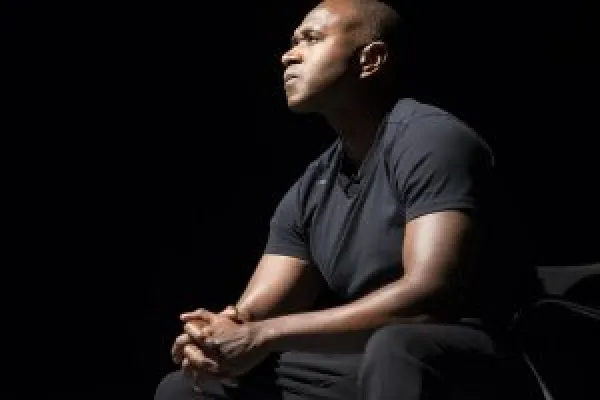
Black! - written and performed by Michael Washington Brown - is not a solo show solely about the African American experience per se. Instead, it is a broader look at people of African origin in England, Jamaica, the U.S.A. and sub-Saharan Africa. In this one-man show Brown incarnates men from these various locations (in fact, in the post-colonial segment of this 90-minute one-acter, he portrays both an interviewer and his interviewee), exploring what the playwright/actor calls in the L.A. premiere’s program the “distinct differences, yet, a very definite similarity between Black people from all walks of life” in disparate parts of our globalized planet.
In doing so Brown confronts stereotypes and varies his accent and demeanor as still and moving images (including of iconic Blacks like boxer/draft resister Muhammad Ali) projected on a screen behind Brown (technical design by Caitlin Rucker) punctuate his extended monologues. The gifted Brown seems to be a likely candidate for this dramatic exercise that’s often lightened by levity. Of Jamaican and Barbadian ancestry, Brown grew up in London, but since 1992 he has lived in California and New York.
Image
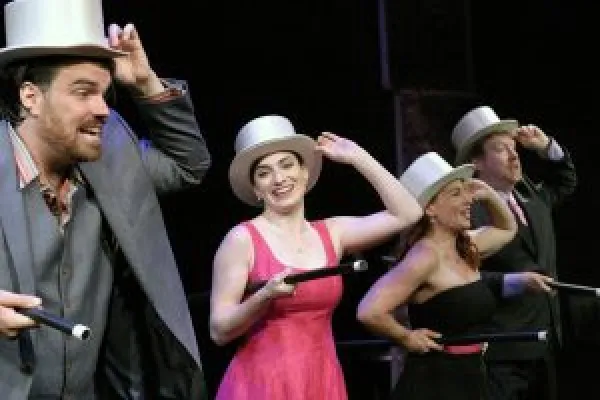
If you’re an aficionado of musicals who hasn’t made a voyage yet to the Odyssey Theatre to experience the siren songs of Side By Side By Sondheim - which has been extended - you still have a couple of weekends left to sail on over to Sepulveda Blvd. Sure to delight fans of plays featuring songs, this revue’s “gimmick” (as Gypsy’s strippers would put it) is that three singers and a narrator (Mark D. Kaufmann, who occasionally croons tunes, too) accompanied by pianists Cheryl Gaul and Richard Berent (also Side’s musical director, he tickles the ivories on a separate keyboard), perform numbers with music and/or lyrics written by Stephen Sondheim.
Image
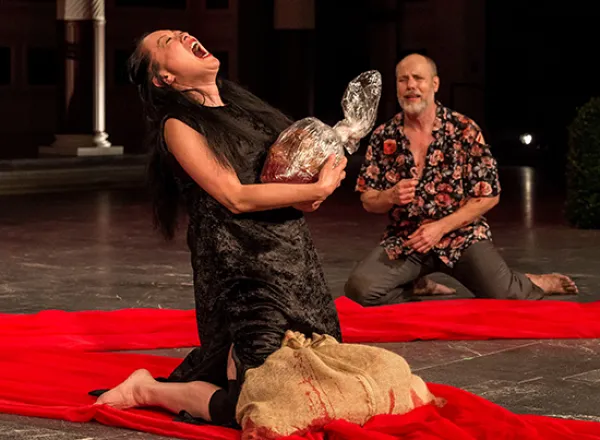
So first of all, let me get this out of the way: I really enjoyed the annual experience of watching an ancient Grecian play performed under the stars at the Getty Villa, seeing and hearing it in an amphitheater the way Greek audiences did when Euripides’ Bacchae opened in 405 BC. The drama pits Dionysus (a whimsical Ellen Lauren) - who, according to press notes, is “the god of divine ecstasy, fertility, wine and harvest… [and] theater” - against Pentheus (Eric Berryman), king of Thebes (the dramatist’s birthplace).
I’m certainly no expert on Greek drama but it seems to me that what Euripides, the playwright of antiquity, was getting at is what Sigmund Freud, the 19th century founder of psychoanalysis, would much later describe in works such as 1930’s Civilization and Its Discontents. That is, the struggle between the id - the unrestrained, instinctual, inner self - and the superego, from whence rules and regulations emanate. Out of this epic clash and collision Classical tragedy is born - and borne.
Image
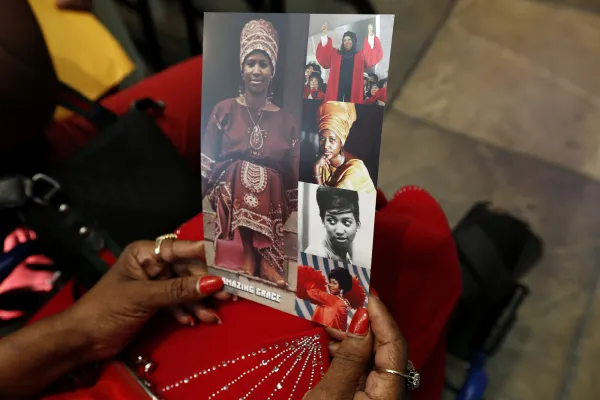
Hollywood is known around the world as a “company town” for the motion picture industry and television, but Los Angeles is also a music Mecca. In January 1972, Aretha Franklin recorded the live album “Amazing Grace” with Rev. James Cleveland’s Southern Californis Community Choir in south L.A., and it became one of America’s bestselling gospel recordings of all time. After her death on August 16, to pay homage to the “Queen of Soul”, selections from that legendary Atlantic Records album were performed on the evening of August 30 at a sonorous, loving Gospel Music Tribute Remembering Aretha Franklin.
Image
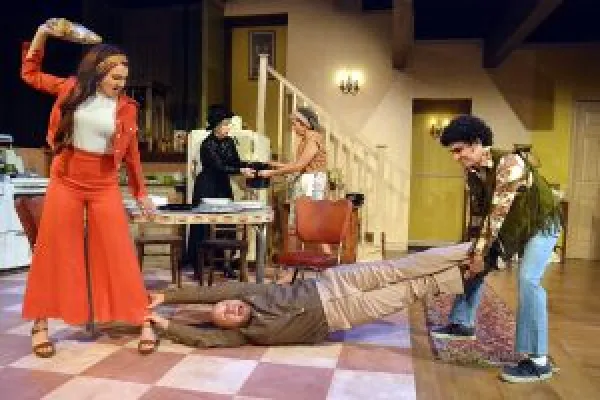
Director/co-playwright/red diaper baby (of sorts) Mark Lonow’s semi-autobiographical Jews, Christians and Screwing Stalin cleverly interweaves the comic and the tragic, the personal and the political. Lonow claims that his grand-uncle Yakov Sverdlov had the distinct honor and pleasure of shooting Czar Nicholas II, and this two-acter has leftwing allusions galore, amidst Turgenev caliber father-son conflicts. Borscht Belt banter is interspersed with socialist shtick.
Co-written with his wife, comedy veteran Jo Anne Astrow, their turf deals with members of Mark’s Marxist meshugenah family, including his grandmother Minka Grazonsky (Cathy Ladman who, appropriately appeared on TV’s Scandal and Mad Men series), who purports to have schtupped Joseph Stalin during the heady days of the Bolshevik Revolution.
Image
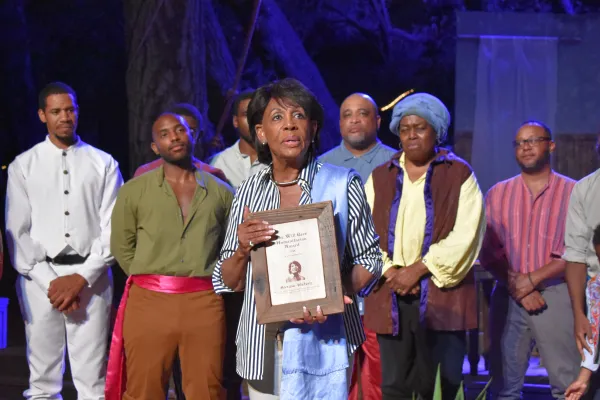
It’s funny how pure chance can affect things. I usually make it a point to attend the premieres of every play at my favorite theatre, Will Geer’s Theatricum Botanicum. Thus I greatly looked forward to driving out to the splendid amphitheater in Topanga Canyon on July 26 for the opening night of the first revival of the 1938 revolutionary play Haiti, A Drama of the Black Napoleon. But it was not to be - the road from Pacific Coast Highway up from Malibu to Topanga was closed, alas.
The following Saturday my disappointment turned into a piece of colossal luck, as I attended the next performance in the repertory season of Haiti - as did that courageous Congresswoman Maxine Waters, in order to receive The Will Geer Humanitarian Award. Before the show began, Congresswoman Waters joined the costumed actors onstage to be presented with the award by WGTB Artistic Director Ellen Geer to an ovation from the audience and cast.
Image
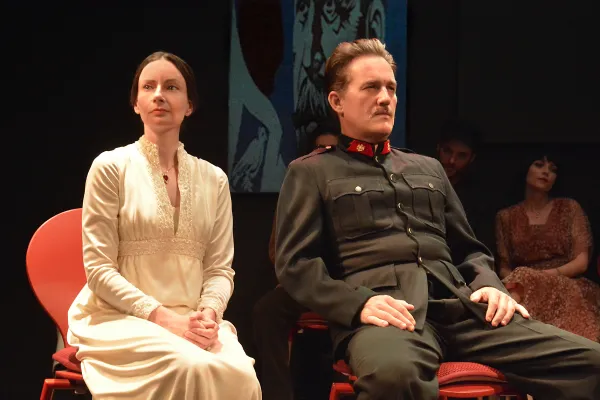
“Stalin is too rude and this defect… becomes intolerable in a Secretary-General. That is why I suggest the comrades think about a way of removing Stalin from that [Central Committee] post and appointing another man in his stead…”
These words were written in December 1922 by V.I. Lenin in what came to be known as the ailing Soviet leader’s Testament. For a third of a century Lenin’s rebuke was - along with much of the Russian Revolution’s radical legacy - suppressed as Joseph Stalin rose to absolute power in the USSR. Three years after “Uncle Joe’s” death, on February 14, 1956 at the 20th Communist Party Congress, the new Soviet Premier, Nikita Khrushchev, dared read Lenin’s Testament aloud as part of his “Secret Speech.” Later that year Lenin’s text was finally published and made public to a people who had been bamboozled, purged and disappeared for decades.